
An NEC award is a tier of recognition, not a single trophy. At the China National Round (CNEC), top teams and individuals earn national-level placement; the strongest then carry that result into the NEC global rounds, where recognition is benchmarked against students worldwide. National recognition says you ranked among the best in China's field; global recognition says you held that standing on an international stage. This guide explains what each tier represents — not the exact medal counts, which you should confirm officially.
Two stages, two kinds of recognition
The National Economics Challenge (NEC) is run by the Council for Economic Education (CEE, founded 1949) and is taken by roughly 10,000 US students a year. For students competing from China, the recognised pathway runs through CNEC — the official China National Round operated by Hanlin (SKT) since 2016, now reaching 20+ provinces and 300+ schools. CNEC is the only official route from China into the NEC global rounds, which means the recognition you can earn arrives in two distinct stages.
The first stage is national recognition, awarded at the CNEC round itself. Here you are ranked against the China field across the competition's seven rounds — the Qualifying Test, Super Econ, Quiz Bowl, Critical Thinking, Econ Lab, Econ Immersion and U20 Youth Voice — and the top performers receive national award tiers. The second stage is global recognition, available to teams that advance from the national round into the international finals. The distinction matters: a national award and a global award are not the same line on a résumé, and they signal different things to a reader.
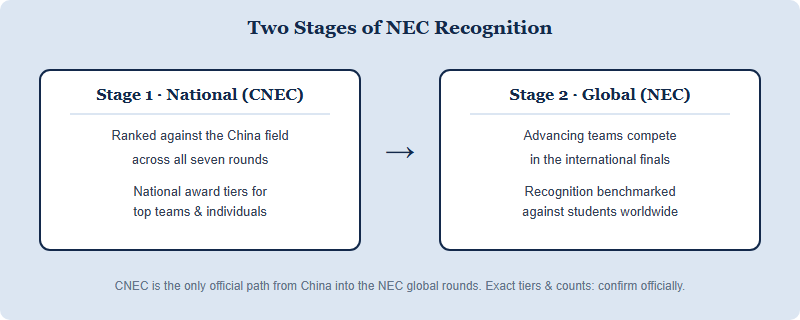
What national (CNEC) recognition represents
National recognition is earned inside the China round. Because CNEC is contested by three divisions — Pre (entry level; entered individually or in a team of two to four), David Ricardo (intermediate; a team of four) and Adam Smith (advanced; a team of four) — an award is always read together with the division it was won in. A top-tier result in the advanced Adam Smith division and a top-tier result in the entry-level Pre division both demonstrate real economics ability, but they sit at different points on the difficulty ladder, and a careful reader will notice which division the recognition came from.
What national recognition genuinely signals is twofold. First, it is field-relative: you placed near the top of everyone who entered CNEC in your division that cycle, which is a stronger statement in a year with a deep field. Second, it is breadth-tested: NEC rewards performance across micro-economics, macro-economics and the world/international economy, and across seven differently-shaped rounds, so a high national placement is hard to reach on a single strength alone. A team that is razor-sharp on quantitative micro-economics but thin on the world economy, or that wins the Quiz Bowl yet stumbles in Critical Thinking, will usually find that gap reflected in its tier — which is precisely why national recognition is taken seriously as an all-round signal.
The specific tier names, the number of awards at each level and the cut-offs are set per cycle — always confirm the current structure on the official CNEC channels rather than assuming last year's applies. It is also worth remembering that the entry-level Pre division can be entered individually or as a small team, whereas David Ricardo and Adam Smith are four-person team events, so a national award in those divisions is a shared, team-level result rather than a solo one. Describing it that way — as a team placement — is both more accurate and more credible.
| Aspect | National recognition (CNEC) | Global recognition (NEC) |
|---|---|---|
| Where it is earned | China National Round | NEC international finals |
| Benchmarked against | The China field, within your division | Students competing worldwide |
| Who is eligible | All registered CNEC teams / individuals | Teams that advance from the national round |
| Read together with | Your division (Pre / David Ricardo / Adam Smith) | The global standard set by the CEE |
| Tier names & counts | Set per cycle — confirm officially | Set per cycle — confirm officially |
What global recognition represents
Global recognition belongs to the second stage. Teams that advance from the China National Round into the NEC global rounds are no longer measured only against China — they are placed alongside students from around the world, against the same academic standard the CEE sets for the competition as a whole. That is the core difference in meaning: a national award says "top of the China field", while a global award says "held that standing internationally".
For a university admissions reader, this is why the two tiers are not interchangeable. Reaching the global rounds at all is itself a recognised outcome, because it requires clearing the national field first; earning a placement once there is a further, distinct signal. A useful way to describe your result honestly is to name both the stage and the division — for example, "advanced to the NEC global rounds via the CNEC Adam Smith division" — rather than collapsing everything into a single vague word like "winner". Whether the global rounds award team honours, individual honours or both, and under exactly which labels, is determined by the CEE per cycle, so confirm the official wording before you describe it on an application.
- National award — top placement within your CNEC division, against the China field.
- Advancement — qualifying from the national round into the global rounds is itself a recognised milestone.
- Global award — a placement earned in the international finals, benchmarked worldwide.
How to read tiers honestly on an application
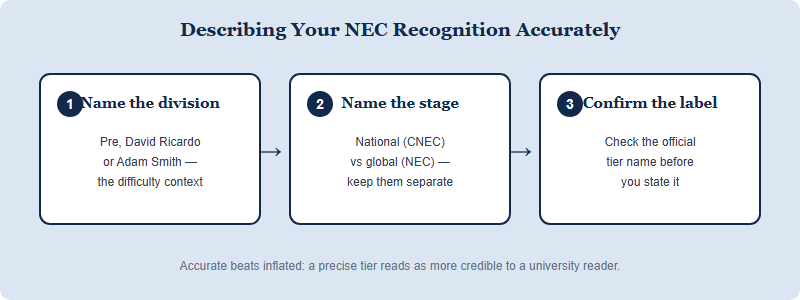
The first-party lesson from running CNEC since 2016 is that the strongest applications describe recognition precisely. Three habits help. Name the division, because Pre, David Ricardo and Adam Smith are not the same challenge and a reader values the context. Name the stage, separating a national CNEC result from a global NEC result instead of merging them. And do not inflate the label: NEC is an academic economics competition, not a guarantee of any admissions outcome, and a clearly-stated, accurate tier reads as more credible than an exaggerated one.
It is equally important to avoid claiming a tier you have not confirmed. The official tier names, the awards available at national and global level, and the cut-offs change from cycle to cycle. Treat any named question-setter or judge associated with the NEC (for example, economists sometimes cited in connection with the competition) as an organiser claim to verify, not an established fact. When you are unsure what your result is formally called, check the official CNEC and CEE materials before writing it down. You can start from the CNEC home page and confirm the current cycle's award structure through the official CNEC channels linked there.
Frequently asked questions
Is a national CNEC award the same as a global NEC award?
No. A national award is earned in the China round against the China field; a global award is earned in the international finals, benchmarked worldwide.
Does the division affect what my award means?
Yes. Pre, David Ricardo and Adam Smith differ in difficulty, so a tier is always read together with the division it was won in.
How many awards are given at each tier?
Award counts and cut-offs are set per cycle. Confirm the current structure on the official CNEC channels rather than assuming previous years.
Is reaching the global rounds itself a recognised result?
Yes. Advancing from the national round requires clearing the China field first, so qualification is a distinct, recognised milestone.
Published by the NEC / CNEC editorial desk, operated by Hanlin Education as the officially authorized China National Economics Challenge (CNEC) test center. The NEC is run by the Council for Economic Education, which sets the official rules — always confirm current dates, divisions, fees and awards on the official CNEC channels. Any error will be corrected within 7 working days.