An effective NEC group prep session is short, scripted and repeatable: a fixed weekly slot of roughly ninety minutes, opened with a timed micro-quiz, anchored by one teammate teaching a topic to the other three, and closed by logging the questions everyone missed. The teams that improve are not the ones that meet most often — they are the ones whose meetings have a known shape, so no session dissolves into four people silently doing problem sets in the same room.
Why a routine beats unstructured group time
The National Economics Challenge is run by the Council for Economic Education (CEE, founded 1949) and draws roughly 10,000 students a year in the United States. It examines three content areas — microeconomics, macroeconomics and the world / international economy — and is contested by small teams: the David Ricardo (intermediate) and Adam Smith (advanced) divisions both run as teams of four, while the Pre division can be entered individually or as a group of two to four. From China, the official route into the competition is CNEC, the China National Round operated by Hanlin (SKT) since 2016 across 20+ provinces and 300+ schools, and the only official path to the NEC global rounds. Because the format is a team format, your preparation should be a team activity — not four parallel solo efforts that happen to share a chat group.
Unstructured group time fails in a predictable way. Everyone agrees to “study together,” the strongest member quietly carries the room, the weaker members feel exposed and go quiet, and the session produces the comfortable feeling of work without the friction that actually moves scores. A routine fixes this by giving every minute a job and every person a turn to speak. The point of meeting is to do the things you cannot do alone: be questioned out loud, explain a model until it survives challenge, and discover the gap between “I recognise this” and “I can produce this under time.”
Group prep is a supplement, not a replacement. Reading a textbook chapter, building flashcards and grinding multiple-choice are solo tasks done between sessions; the meeting is where you stress-test what you each did. A useful rule of thumb: if an activity works just as well alone, it does not belong in the shared slot.
A weekly cadence that holds for months
Pick one fixed ninety-minute slot per week and protect it like a class. Consistency beats intensity: a team that meets every Wednesday for three months out-prepares a team that does occasional four-hour weekend marathons, because the weekly rhythm spaces retrieval and keeps momentum through exam season. Within the slot, run the same four phases every time so nobody has to decide what happens next.
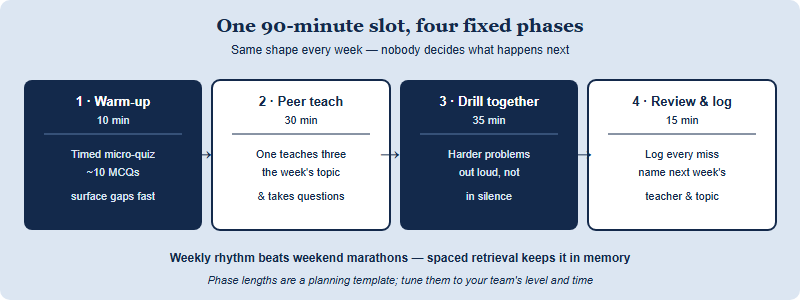
Three habits make the cadence survive a long season. First, rotate the chair — a different teammate runs the clock and agenda each week, so the routine never depends on one person showing up. Second, set next week before you leave: name the teacher and topic in the last five minutes, so prep happens between sessions instead of in a scramble at the start of the next one. Third, keep a one-line attendance and topic record in the same shared document as your error log, so a glance tells you which content areas you have actually covered versus the ones you keep postponing.
Three drilling formats that pull their weight
Doing problems silently in a room is the most common — and least useful — way a team drills. The friction that builds recall comes from doing it out loud and against a clock. Three formats cover most of what a NEC team needs, and you should rotate them so sessions do not get stale.
- The rapid round. One person reads multiple-choice questions aloud; the others answer fast, then the reader asks “why is it B, and why is it not C?” This mirrors the recall-under-time demand of the Qualifying Test that every team member sits, and the wrong-answer reasoning is where the learning lives.
- The whiteboard explain. For anything diagram-based — a supply-and-demand shift, an AD–AS adjustment, a tariff's welfare effect — one teammate draws and narrates while another deliberately plays the skeptic: “what happens to surplus here?” Drawing a model under questioning exposes the half-understood steps that flashcards never reach.
- The buzz drill. Run a few quick-fire definition and identification rounds against a timer to rehearse the fast, knowledge-recall feel of a head-to-head round, then immediately switch to a short open-discussion problem to rehearse the reasoning feel of an analytical task. Alternating the two keeps both gears warm.
The NEC is contested across seven rounds — Qualifying Test, Super Econ, Quiz Bowl, Critical Thinking, Econ Lab, Econ Immersion and the U20 Youth Voice — and the exact format, scoring and ordering of those rounds should always be confirmed on the official CNEC channels, because they can change by season and division. You do not need a separate drill for every round. You need to rehearse the two underlying gears the formats demand: fast factual recall and slower applied reasoning. The table below maps the formats above onto those gears and the broad round types, as a study aid rather than a description of the official rules.
| Drilling format | Skill it builds | Broad round type it rehearses | Group size |
|---|---|---|---|
| Rapid round (MCQ aloud) | Recall under time + wrong-answer reasoning | Timed-test style rounds | All four together |
| Whiteboard explain | Producing and defending a model | Analytical / applied rounds | Pairs, then swap |
| Buzz drill | Fast identification + composure | Head-to-head / quiz-style rounds | Two-on-two |
| Open-case discussion | Structured argument from data | Critical-thinking / case rounds | All four, one chairs |
Whatever you build your drills from, anchor them to the official academic standard: the CEE sets the syllabus, so confirm which topics and round formats are examinable on the official CNEC channels before you over-invest in any one drill.
Peer-teaching: the engine of a good session
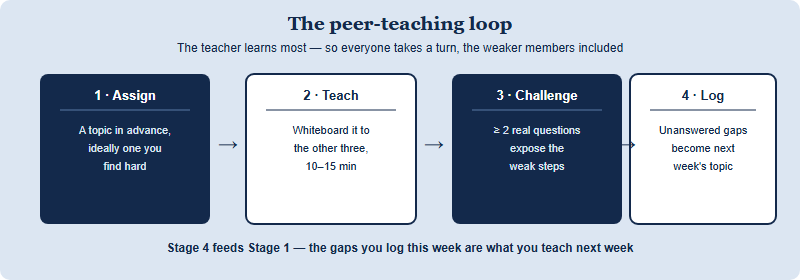
The single highest-leverage thing four people can do together is take turns teaching. When a teammate has to explain price elasticity or the money multiplier to the other three — on a whiteboard, taking interruptions — two things happen at once. The teacher discovers exactly which parts of their own understanding are shaky, because you cannot fake your way through an explanation under questioning. And the listeners get the topic in a peer's language, which often lands better than the textbook's.
Make it a rule that everyone teaches, including — especially — the weaker members. Being assigned to teach the topic you find hardest is the fastest way to stop finding it hard. Keep three guardrails: rotate so the confident member is not always the teacher; cap each explanation at ten to fifteen minutes so it stays focused; and require the listeners to ask at least two genuine questions, because a teach with no challenge is just a lecture nobody checked. End every peer-teach by having the teacher pose one quick question back to the group, which both confirms the room followed and feeds your error log.
Dividing the practice fairly across four people
Splitting the work of preparing is different from splitting who answers what on competition day — that role and round mapping is its own decision. Here the question is narrower: across a long season, who sources problems, who builds the shared flashcard set, who keeps the error log current, and who scouts past-paper material? Spread these chores so one conscientious teammate is not silently doing all the admin while the others only show up to drill.
A simple, rotating split works well. Give each teammate a standing job for a month, then rotate, so everyone learns to run the machinery and nobody burns out:
- Quizmaster — assembles each week's warm-up MCQs and runs the rapid round.
- Scribe — owns the shared error log and the attendance/topic record, and reads back last week's misses at the start of each session.
- Materials lead — gathers practice problems and past-paper sets and confirms, against the official CNEC channels, which formats are worth drilling this season.
- Timekeeper — chairs the session, holds the clock to the four phases, and sets next week's teacher and topic before the group leaves.
The reason to divide chores rather than dividing subjects to study in isolation is that every team member sits the same individual test, so each of you needs working command of all three content areas regardless of who happens to be strongest in macro. Share the running of the team; do not let anyone opt out of a whole subject. For the wider picture of how the rounds and divisions fit together, keep the CNEC overview open as you plan, and treat your routine as the thing that turns that syllabus into reps.
Frequently asked questions
How often should an NEC team meet to prepare?
One fixed weekly session of around ninety minutes works for most teams. A steady weekly rhythm spaces retrieval far better than occasional long marathons.
What should we actually do together versus alone?
Do reading, flashcards and solo problem sets between sessions. Reserve the shared slot for being questioned out loud, peer-teaching and timed drilling — the things you cannot do alone.
Should we split the syllabus so each person learns one subject?
No. Every member sits the same individual test, so each needs all three content areas. Divide the prep chores, not the subjects.
Does this match the official NEC round format?
The session shape is a study routine, not the rules. Confirm current divisions, rounds, scoring and dates on the official CNEC channels.
Published by the NEC / CNEC editorial desk, operated by Hanlin Education as the officially authorized China National Economics Challenge (CNEC) test center. The NEC is run by the Council for Economic Education, which sets the official rules — always confirm current dates, divisions, fees and awards on the official CNEC channels. Any error is corrected within 7 working days.