
The NEC rarely asks you to define aggregate demand and aggregate supply. It asks you to diagnose a shock: identify whether a one-line event hit AD or AS, predict what happens to output and the price level in the short run, and explain how the economy adjusts back in the long run. The single most decisive split is demand shocks (output and prices move together) versus supply shocks (they move in opposite directions) — the engine behind stagflation questions.
The first decision: did the event hit AD or AS?
Every AD-AS shock item starts with one classification, and getting it wrong cascades through the whole answer. Aggregate demand is total planned spending — consumption, investment, government spending, and net exports. Anything that changes one of those at a given price level shifts the AD curve. Aggregate supply is the economy's willingness and ability to produce; the short-run AS curve (SRAS) shifts when production costs or productive capacity change.
A reliable test the NEC rewards: ask “is this a spending event or a cost/capacity event?” A surge in consumer confidence, a tax cut, or a rise in export demand is spending → AD. An oil-price spike, a poor harvest, a jump in the minimum wage, or a new productivity-boosting technology is cost or capacity → AS. The trap items deliberately blur this: a fall in business confidence reduces investment (a component of AD), so it shifts AD left — not AS — even though it sounds like it is “about firms.”
| Event in the prompt | Curve that shifts | Direction | Why |
|---|---|---|---|
| Income-tax cut for households | AD | Right | Higher disposable income raises consumption |
| Collapse in business confidence | AD | Left | Lower planned investment (a component of AD) |
| Sharp rise in world oil prices | SRAS | Left | Higher input costs at every output level |
| Major productivity-raising technology | SRAS / LRAS | Right | Lower unit costs and higher capacity |
| Stronger demand for the country's exports | AD | Right | Net exports rise |
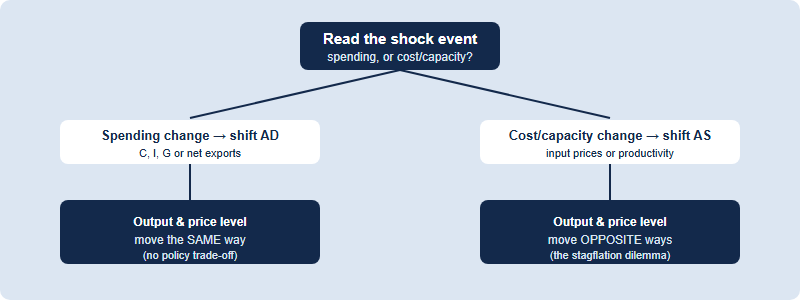
The signature that separates demand shocks from supply shocks
Here is the diagnostic that earns marks fastest. Compare what happens to real output and the price level together:
- Demand shock — real GDP and the price level move in the same direction. A positive demand shock raises both (growth with inflation pressure); a negative demand shock lowers both (recession with disinflation).
- Supply shock — real GDP and the price level move in opposite directions. An adverse supply shock lowers output while raising the price level — that is stagflation. A favourable supply shock raises output while easing prices.
This is why examiners love supply shocks: they break the comfortable assumption that “more output means higher prices.” Whenever a question reports rising prices and falling output in the same period, you should reach immediately for an adverse supply shock, not a demand story. Stating this co-movement rule explicitly — before you draw or describe anything — signals to a judge that you understand the mechanism rather than memorising a picture.
Short run versus long run: the self-correction mechanism
The hardest AD-AS marks sit in the adjustment question: “What happens next?” In the short run, SRAS is upward-sloping because some input prices — especially nominal wages — are sticky. In the long run, those prices adjust, and long-run aggregate supply (LRAS) is treated as vertical at the economy's potential output. The gap between where the economy lands in the short run and potential output drives the self-correction.
Trace a positive demand shock: AD shifts right, the economy produces above potential, and an inflationary gap opens. Because output exceeds potential, labour and resources are scarce, nominal wages and input costs eventually rise, SRAS drifts left, and the economy returns to potential output — but at a permanently higher price level. The reverse holds for a negative demand shock: a recessionary gap, falling wages, SRAS drifting right, and a return to potential at a lower price level. The textbook lesson the NEC tests is that, left alone, demand shocks change the price level permanently but output only temporarily.
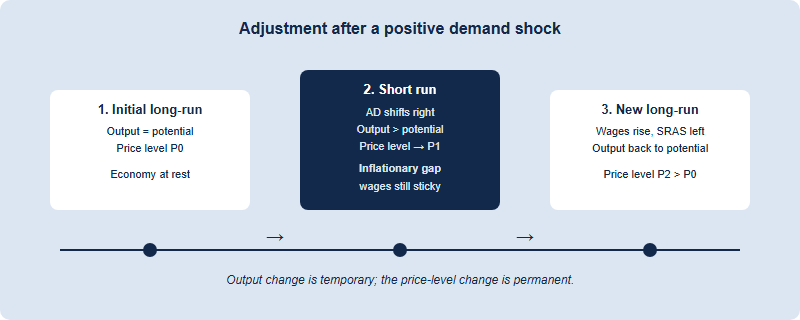
Supply shocks adjust differently, and that difference is exactly what makes them harder. After an adverse supply shock there is no automatic, painless return: if policymakers do nothing, the textbook view is that the higher costs eventually unwind and SRAS drifts back — but only slowly and through a painful period of high prices and weak output. That sluggish, asymmetric recovery is the heart of the stagflation problem below.
Why supply shocks create the stagflation dilemma
Stagflation — stagnant output plus inflation — is the marquee supply-shock scenario, and the NEC tests it because it exposes whether you actually understand the model or just memorised “recession = stimulate.” The dilemma is a genuine policy trap. After an adverse supply shock, output is below potential and the price level is rising at the same time. The two standard demand-side responses point in opposite directions:
- Fight the recession — expansionary fiscal or monetary policy shifts AD right, restoring output, but pushes the price level even higher (worse inflation).
- Fight the inflation — contractionary policy shifts AD left, easing prices, but deepens the output loss and unemployment.
A demand-management tool can therefore fix one problem only by worsening the other; it cannot fix both at once. The genuinely strong NEC answer names this trade-off explicitly and then notes that the durable cure for an adverse supply shock is supply-side — measures that lower costs or raise productivity push SRAS back to the right, improving output and prices together, though typically with a longer time lag. Contrast this with a demand shock, where there is no such dilemma: output and prices move together, so a single demand-side response addresses both.
| Dimension | Adverse demand shock | Adverse supply shock |
|---|---|---|
| Curve that shifts | AD left | SRAS left |
| Real output | Falls | Falls |
| Price level | Falls | Rises |
| Output & prices co-move? | Same direction | Opposite directions |
| Policy trade-off? | No — one tool fixes both | Yes — the stagflation dilemma |
| Most durable cure | Demand-side stimulus | Supply-side (cost/productivity) |
Turning the model into NEC marks
In timed rounds, AD-AS items reward a fixed answer skeleton rather than improvisation. Drill this four-step routine until it is automatic: (1) classify the shock as AD or AS and state the direction; (2) give the short-run effect on output and the price level, citing the co-movement signature; (3) describe the long-run adjustment toward potential output; (4) if asked, name the policy response and — for supply shocks — flag the trade-off. Because NEC scoring spans both fast recall formats and reasoning-heavy components, the same conceptual chain has to survive under speed and hold up to argument. For how these macro items are distributed across the seven NEC rounds, our NEC China resource hub maps content to format.
A first-party note from running the China round (CNEC) since 2016, across 20+ provinces and 300+ schools: the place we see Chinese international-school students lose AD-AS marks is almost never the curve diagram — it is the direction of co-movement on supply shocks. Strong AP and IB students will correctly shift SRAS left, then reflexively write “output and prices both fall,” importing the demand-shock pattern. We coach the co-movement rule as a deliberate checkpoint precisely because it is the single highest-frequency error in our cohort scripts. The macroeconomics content itself follows the Council for Economic Education's official standard; for the exact rounds, divisions and dates each cycle, always check the official CNEC pages, and you can review how the divisions differ on our competition overview.
FAQ
How do I tell a demand shock from a supply shock in an NEC question?
Check output and the price level together: same direction means a demand shock; opposite directions means a supply shock.
What exactly causes stagflation in the AD-AS model?
An adverse supply shock shifts SRAS left, lowering output while raising the price level — stagnation and inflation at once.
Why can't one policy fix a supply shock?
Demand-side policy moves AD one way, so it eases either the recession or the inflation but worsens the other — the trade-off. Supply-side measures are the durable cure.
Does output stay changed after a demand shock?
No. In the long run wages and costs adjust, SRAS shifts, and output returns to potential; only the price level change is permanent.
Published by the NEC / CNEC editorial desk, operated by Hanlin Education as the officially authorized China National Economics Challenge (CNEC) test center. The NEC is run by the Council for Economic Education, which sets the official rules — always confirm current dates, divisions, fees and awards on the official CNEC channels. Corrections are made within 7 working days.