
The National Economics Challenge (NEC) draws every question from three subject pillars: microeconomics, macroeconomics and the international (world) economy. Run by the Council for Economic Education (CEE), the NEC spreads its content across all three rather than rewarding one. The most common preparation mistake we see in the China National Round (CNEC) is treating them as equal, separate piles instead of one connected map.
The three pillars are a syllabus, not three silos
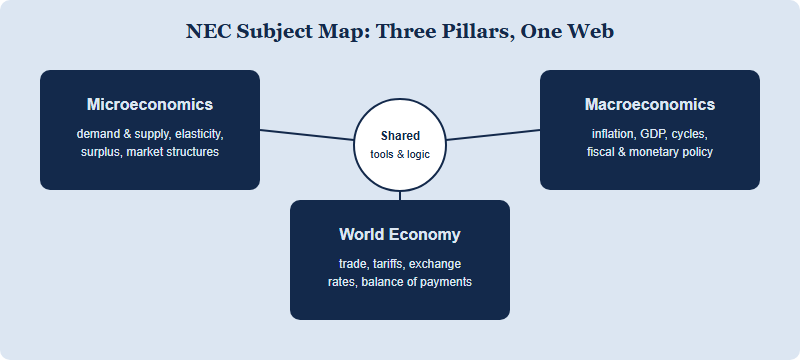
Most students arrive picturing NEC content as three boxes to study in turn. That framing causes two failures: it hides how much the pillars overlap, and it leads people to “finish” micro, declare it done, and never revisit it. In reality the syllabus behaves more like a web. A single world-economy question on tariffs leans on micro tools (surplus, deadweight loss) and macro context (trade balances, exchange-rate effects). A macro question on growth borrows micro logic about productivity and capital. The CEE sets the official academic standard for what is examinable; the practical takeaway is that the three pillars are best learned as one connected body of theory.
For students reaching the NEC global rounds through China, the CNEC—operated by Hanlin (SKT) as the officially authorized China test center since 2016, now spanning 20+ provinces and 300+ schools—is the route. Across that cohort, the pattern is consistent: the strongest performers are not the ones who memorize the most facts in one pillar, but the ones who can move fluidly between all three when a question demands it.
How the coverage actually splits
The NEC does not publish a fixed public percentage breakdown of micro vs macro vs world economy, and weighting can vary by round and division—so always treat any specific split as an approximation and confirm scope on the official CNEC channels. What we can say with confidence is the shape of the coverage, drawn from the CEE's stated subject scope and the recurring themes students meet.
| Pillar | Representative scope | Where it shows up |
|---|---|---|
| Microeconomics | Supply & demand, elasticity, surplus & deadweight loss, market structures, externalities, factor markets | Heavy in the foundational rounds; underpins many world-economy questions too |
| Macroeconomics | Inflation & CPI, unemployment, GDP & growth, business cycles, fiscal & monetary policy | Core throughout; rewards students who connect policy to outcomes |
| World / international economy | Comparative advantage, trade & tariffs, exchange rates, balance of payments, global institutions | The differentiator—often the thinnest in student preparation |
Where China students over-prepare
Two over-investment patterns recur in the CNEC cohort, and both come from familiar comfort zones:
- Over-drilling micro diagrams. Students who have done IB or A-Level economics often pour hours into perfecting supply-and-demand and market-structure graphs. These are genuinely important—but past a point of fluency, extra repetition yields little new marks. The diagram skill matters; re-drawing the same five graphs for the tenth week does not.
- Memorizing macro definitions in isolation. A second comfort zone is collecting definitions—every measure of unemployment, every monetary tool—without practising how they interact. NEC questions rarely ask “define CPI.” They ask you to reason about what happens next when a policy lever moves, which is a different skill from recall.
Over-preparation is not “studying too much economics.” It is spending your marginal study hour where it no longer changes your score. The fix is to redirect that hour toward the pillar and the skill that is genuinely weaker.
There is also a subtler over-investment: polishing a pillar because it feels productive. Re-reading a chapter you already understand produces the comforting sensation of progress without testing whether you can apply it under time pressure. In the CNEC cohort, the students who plateau are frequently the diligent ones who confuse hours logged with marks gained. A blunt rule helps: if you can already score well on a topic in timed conditions, that topic is no longer where your study time should go—regardless of how much you enjoy it.
Where China students under-prepare
The under-prepared zone is almost always the world economy, and the reasons are structural rather than about effort. International economics tends to sit late in school syllabuses, so many students simply reach competition season having spent the least classroom time on it. Yet world-economy questions are frequently where placements are decided, precisely because fewer competitors are strong there.
Within world economy, the most commonly thin areas are exchange-rate logic (appreciation vs depreciation and their knock-on effects) and balance of payments (how the current and capital accounts fit together). The second under-prepared zone cuts across all three pillars: cross-pillar reasoning—the ability to answer a question that is “world economy on the surface, micro and macro underneath.” Students who only ever studied each pillar in its own session struggle the moment a question braids them together.
| Comfort zone (often over-prepared) | Blind spot (often under-prepared) | Rebalancing move |
|---|---|---|
| Perfecting micro diagrams you already draw fluently | Exchange rates & balance of payments | Swap one micro-drill session for a world-economy set each week |
| Memorizing macro definitions in isolation | Reasoning about how policies and outcomes interact | Practise “what happens next” scenarios, not flashcards |
| Studying each pillar in a separate session | Cross-pillar questions that braid all three | Mix pillars within one practice block |
A balanced coverage plan
Because exact weightings are not published, the safest strategy is not to chase a perfect ratio but to make sure no pillar is neglected and that cross-pillar practice exists at all. A simple, defensible default for a study block looks like this:
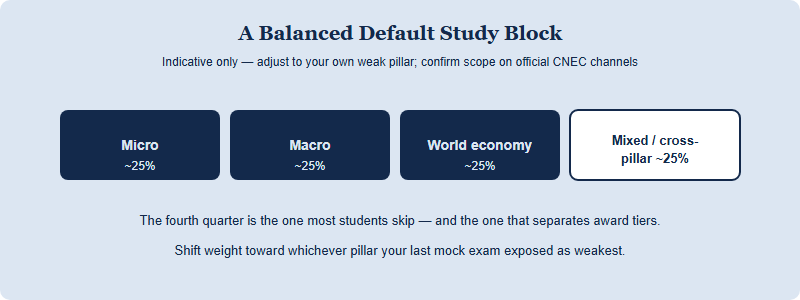
The discipline that makes this work is the mock exam. Track your accuracy by pillar, not just your total score. A 70% overall mark might hide a 90% micro and a 45% world economy—and only the per-pillar view tells you where the next study hour belongs.
Running that audit is simple. After each mock, sort every question you got wrong into one of the three pillars (and, where a question clearly braids two, tag it as cross-pillar). Tally the misses per category over three or four mocks so a single bad day does not distort the picture. The pillar with the most repeated errors is your real priority; the cross-pillar tally tells you whether your weakness is a subject gap or a “joining-the-dots” gap. Re-run the audit monthly—weak spots move as you study, and the plan should move with them. For a fuller picture of how the season fits together, see our NEC editorial home and the round-by-round and division guides linked there.
How division choice changes the map
The three pillars exist across all divisions, but the depth expected differs. The NEC runs three divisions—Pre (entry; individual or a team of 2–4), David Ricardo (intermediate; team of 4) and Adam Smith (advanced; team of 4). As you move up, the same three subjects are examined more deeply and the cross-pillar questions get harder. A team in the David Ricardo or Adam Smith division can also use the map to its advantage: the world-economy pillar is a natural specialism to assign to a teammate, since it is where opponents are most often thin. Picking the right division is itself a coverage decision; if you are weighing that up, the division-choice and eligibility guidance on our CNEC site walks through it.
Frequently asked questions
Does NEC weight micro, macro and world economy equally?
NEC doesn't publish fixed weightings, and they can vary by round and division. Treat coverage as roughly balanced and confirm scope on official CNEC channels.
Which pillar do China students most often neglect?
The world economy—trade, exchange rates and balance of payments—because it tends to sit late in school syllabuses and gets the least classroom time before competition.
Can I just focus on the pillar I'm strongest in?
No. NEC draws from all three and braids them in single questions, so a neglected pillar caps your score. Balance plus cross-pillar practice wins.
How do I find my weak pillar?
Run mock exams and track accuracy per pillar, not just the total. A strong overall score can hide one weak subject that costs you placement.
Published by the NEC / CNEC editorial desk, operated by Hanlin Education as the officially authorized China National Economics Challenge (CNEC) test center. The NEC is run by the Council for Economic Education, which sets the official rules—always confirm current dates, divisions, fees and awards on the official CNEC channels. Any errors will be corrected within 7 working days.