
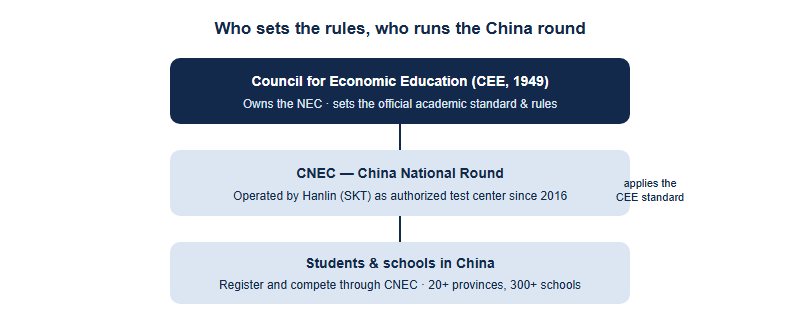
CNEC is the official China National Round of the NEC (National Economics Challenge). The NEC itself is run by the Council for Economic Education (CEE, founded 1949), which sets the academic standard; Hanlin (SKT) has operated CNEC as the authorized China test center since 2016, reaching 20+ provinces and 300+ schools, and it is the only official path from China to the NEC global rounds.
What “CNEC” actually means — and what it does not
For families in Chinese international schools, the single most useful thing to get straight is the relationship between three names that are easy to blur together. The NEC is the competition — a US-rooted economics challenge that draws roughly 10,000 students a year in the United States and tests three subject areas: microeconomics, macroeconomics, and the world (international) economy. The CEE is the organisation that owns and governs that competition; it defines the divisions, the rounds, the rules and the academic bar. CNEC is the localized national round that lets students sitting in China take part under those same rules without flying to a US regional event first.
So CNEC is not a separate competition, a “China-only” knock-off, or a different syllabus. It is the NEC, administered in China by an authorized operator. That distinction matters because it tells you where authority sits. The academic standard is set in one place (the CEE); the in-country logistics — registration windows, venues or proctoring, team verification, results and the hand-off upward — are executed by another (Hanlin, as the CNEC test center). When you read a rule on an official CNEC page, you are reading the CEE’s standard applied to the China round, not a local reinterpretation of it.
Why an “official test center” exists at all
A reasonable question from parents is: if the NEC is a US competition, why does China need a designated operator rather than students simply signing up online? The answer is structural integrity. A national academic competition only carries weight if results are administered consistently — the same rules, the same team definitions, the same eligibility verification, the same proctoring discipline — so that a result earned in Shanghai is comparable to one earned in Chengdu, and so that what advances onward is credible to the body running the global stage. An authorized in-country test center is how the CEE extends that consistency across a border without diluting it.
That is the role Hanlin has played since 2016. Operating CNEC means running the China round end to end: opening registration, confirming that each team meets the division rules, administering the competition, reporting scores, and managing the official hand-off of qualifying teams toward the NEC global rounds. The footprint — 20+ provinces and 300+ schools — is not a marketing flourish; it is the practical reason a student in a second-tier city can enter the same competition, under the same standard, as a student in a flagship international school in Beijing. The breadth is what makes “national round” an accurate description rather than a regional one.
It is worth stating the limit of this role plainly, because honesty here is part of the value. Hanlin runs the China round; it is not the CEE, and it does not author the rules. Where you see named economists associated with the competition’s question-setting or judging — figures such as Mankiw or Shiller are sometimes cited — treat those as organiser claims to confirm through official channels, not as independently verified facts. The reliable claim is the one that holds regardless: the CEE sets the standard, CNEC applies it in China, and the path between the two is sanctioned rather than improvised.
How CNEC maps onto the NEC’s divisions and rounds
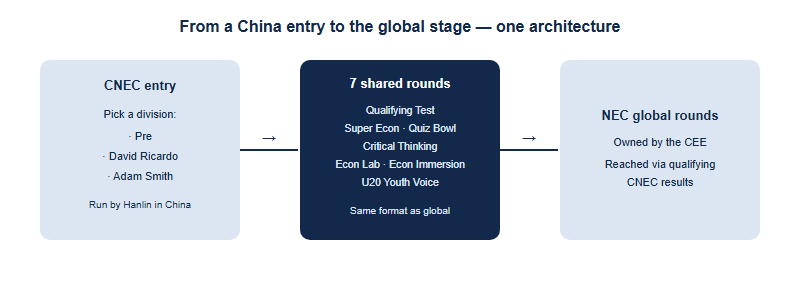
Because CNEC runs the NEC’s actual format, the architecture a student meets in China mirrors the global one. The NEC is organised into three divisions by experience level, and the round structure underneath them is the same set of seven challenges. Understanding the shape — without treating any specific schedule or cutoff as fixed — is the fastest way to see how a China entry connects to the wider competition.
| Division | Level | Team format |
|---|---|---|
| Pre | Entry | Individual or a team of 2–4 |
| David Ricardo | Intermediate | Team of 4 |
| Adam Smith | Advanced | Team of 4 |
Your division choice at the CNEC stage is therefore not just a difficulty setting — it places you within the NEC’s own ladder. A grade 8–10 newcomer often starts in Pre or steps up to David Ricardo as a first team experience, while a confident, well-prepared roster aims at Adam Smith, where the world-economy material carries the most weight. The seven rounds that sit beneath all three divisions are the Qualifying Test, Super Econ, Quiz Bowl, Critical Thinking, Econ Lab, Econ Immersion, and U20 Youth Voice. CNEC administers these in China; the global rounds use the same vocabulary, which is precisely why the national round is a true on-ramp rather than a detour.
The “only official path” — what that phrase really commits to
When CNEC is described as the only official path from China to the NEC global rounds, the claim is specific and worth unpacking, because students sometimes assume there must be a back door — a direct US registration, or a third-party shortcut. There is not. For a student based in China, participation in the NEC and any advancement toward its global stage runs through the authorized national round. That is what “official” buys you: a route the governing body recognises, with results that are accepted upward, rather than an unsanctioned entry that may not be honoured at all.
This is also where a first-party perspective is genuinely useful rather than promotional. Having operated the China round since 2016 across 20+ provinces, the recurring confusion we see is rarely about economics content — it is about process: families unsure whether to register a team or an individual, unsure which division commits them to which track, or unsure where the authoritative dates live. The practical guidance is consistent. Decide your division early, because in China as everywhere the unit that advances in the competitive divisions is the four-person roster, not a lone student. And treat the official CNEC channels as the single source of truth for any number attached to a season. The structure on this page is stable; a specific registration deadline, fee, scoring threshold or award quota is not ours to invent, and the honest instruction is always to confirm it officially.
If you are mapping out where this sits in a longer plan, two companion reads help: a season-level view of how a China entry hands off upward, and the CNEC home page for current-cycle specifics. Pair this identity overview with our walkthrough of how advancement from the national round to the global rounds actually works, and you will have both halves — what CNEC is, and how it moves you onward.
Frequently asked questions
Is CNEC a different competition from the NEC?
No. CNEC is the official China National Round of the NEC, run by Hanlin under the CEE’s rules — same divisions, same format, applied in China.
Who actually runs the NEC versus CNEC?
The Council for Economic Education (founded 1949) owns the NEC and sets the standard. Hanlin (SKT) has operated CNEC as the authorized China test center since 2016.
Can a student in China register for the NEC directly online instead?
For students in China, CNEC is the only official path to the NEC global rounds. Confirm current entry steps on the official CNEC channels.
How widely does CNEC operate?
CNEC reaches 20+ provinces and 300+ schools, which is what makes it a genuine national round rather than a single-city event.
Published by the NEC / CNEC editorial desk, operated by Hanlin Education as the officially authorized China National Economics Challenge (CNEC) test center. The NEC is run by the Council for Economic Education, which sets the official rules — always confirm current dates, divisions, fees and awards on the official CNEC channels. Any error is corrected within 7 working days.