
The National Economics Challenge (NEC) tests government intervention not as a policy debate but as a diagram you must read in seconds: a binding price ceiling set below equilibrium creates a shortage, a binding price floor set above equilibrium creates a surplus, and a quota caps the quantity that can legally trade. The single fact that decides every question is whether the control is binding — on the restrictive side of the market price — and every binding control destroys some mutually beneficial trades.
Binding vs non-binding: the test that comes first
Before you reason about shortages or surpluses, NEC items demand one prior judgement: is the control binding at all? A price ceiling is a legal maximum price; it only changes the market if it sits below the equilibrium price. A price floor is a legal minimum; it only bites if it sits above equilibrium. Set a ceiling above the going price, or a floor below it, and nothing happens — the market clears as if the law were absent. This is the classic distractor: an item gives you a price control that is not binding, and the trap answer assumes it must cause a shortage or surplus anyway.
The reasoning rests on the free-market equilibrium that the CNEC foundation in microeconomics establishes first. Locate the equilibrium price, then ask which side of it the control sits on. A first-party tip from coaching CNEC teams: write a one-line check before touching the answer choices — “Ceiling below market = bites; floor above market = bites; otherwise ignore it.” That reflex alone clears a surprising number of Qualifying Test and Quiz Bowl items where the whole question is a binding/non-binding misdirection.
Price ceilings and the anatomy of a shortage
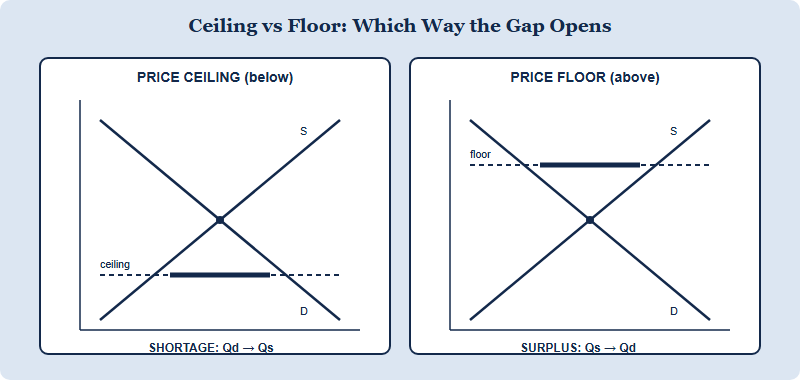
A binding price ceiling — rent control and anti-gouging caps are the stock NEC examples — holds price below the level that clears the market. At that artificially low price, quantity demanded rises while quantity supplied falls, and the gap between them is the shortage. The exam-critical subtlety is that the shortage is not simply “high demand”; it is the simultaneous movement of both quantities in opposite directions along their curves. Students who describe only the demand side lose the half of the answer graders are looking for.
Because price can no longer ration the good, something else must. NEC critical-thinking prompts reward students who can name the non-price rationing that fills the vacuum: queues and waiting lists, first-come-first-served, favouritism, quality deterioration, and black markets where the good resells above the legal cap. There is a second-order point worth stating cleanly: a shortage tends to worsen over time, because supply is more elastic in the long run — landlords convert units to other uses, producers exit — so the quantity supplied keeps shrinking. Tying the size of the gap to elasticity is exactly the kind of layered reasoning the higher divisions described on the official CNEC programme ask for in written rounds.
Price floors and the anatomy of a surplus
A binding price floor is the mirror image. Held above equilibrium, it pushes quantity supplied up and quantity demanded down, and the excess supply is the surplus. The two canonical NEC examples are the minimum wage (a floor in the labour market, where the “good” is hours of labour and the surplus is unemployment) and agricultural price supports (where the surplus is unsold crops the government may end up buying and storing). Reading a labour-market floor correctly — surplus of labour = workers who want jobs at the wage but cannot find them — is a frequent stumbling block precisely because the vocabulary changes even though the diagram does not.
The symmetry is worth memorising as a single template, because NEC writers test the two controls side by side to see who has internalised the pattern versus who memorised one case. The table below is the comparison students should be able to reconstruct from memory before walking into the Qualifying Test.
| Feature | Price ceiling (binding) | Price floor (binding) |
|---|---|---|
| Legal nature | Maximum price, set below equilibrium | Minimum price, set above equilibrium |
| Result | Shortage (Qd > Qs) | Surplus (Qs > Qd) |
| Quantity actually traded | Falls to quantity supplied | Falls to quantity demanded |
| Stock exam example | Rent control, anti-gouging caps | Minimum wage, farm price supports |
| Side-effect to name | Queues, black markets, quality decline | Unemployment, unsold inventory |
| If not binding | No effect (ceiling above market) | No effect (floor below market) |
Quotas: capping the quantity instead of the price
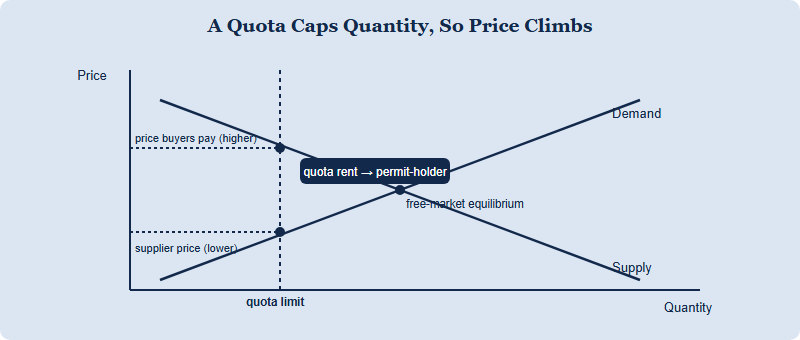
A quota attacks the market from the other axis. Rather than fixing a price and letting quantity adjust, a quota fixes the maximum quantity that may be produced, sold, or imported, and lets price find its own level on top of that cap. When the quota is set below the free-market quantity, it forces output down; with less available, the price buyers are willing to pay rises along the demand curve. NEC items use production quotas (taxi medallions, fishing limits) and import quotas as the standard cases — and an import quota is a frequent crossover with the trade section, distinct from the tariff analysis covered elsewhere.
The point most students miss: a quota creates a gap between the price buyers pay and the lowest price suppliers would accept for that restricted quantity. That gap is captured as a windfall by whoever holds the legal right to sell — the licence-holder, the medallion owner, the importer with the permit. This is the quota rent, and it is the quota analogue of who-captures-the-surplus reasoning. Being able to say “the restriction raises price, lowers traded quantity, and hands a rent to the permit-holder” in one sentence is the kind of precise, first-party framing that distinguishes strong written answers under time pressure.
The welfare verdict: every binding control destroys value
The thread that unifies ceilings, floors, and quotas is efficiency. Each one pushes the quantity actually traded below the competitive quantity, and that shortfall means some trades whose value to the buyer exceeded their cost to the seller simply never happen. The value of those lost trades is the deadweight loss — the same welfare logic that consumer and producer surplus analysis builds, applied to intervention rather than to a free market. (Measuring the triangular areas precisely is its own topic; here the point is the direction, not the area arithmetic.)
That is why NEC critical-thinking and Econ Lab prompts almost never accept “the policy is good” or “the policy is bad” as a complete answer. The expected move is to name the trade-off: a rent ceiling may protect existing tenants and shrink the housing stock while spawning queues; a minimum wage may raise pay for those who keep jobs and price others out; an import quota may shield domestic producers and raise consumer prices while handing rents to permit-holders. Distributional goals on one side, efficiency cost on the other. Stating both, with the deadweight loss explicitly identified, is what separates a defensible argument from an opinion in the analytical rounds.
Because this supply-and-demand machinery powers price controls, taxes, surplus analysis, and trade policy alike, drilling the binding/shortage/surplus/quota template is high-leverage preparation: the payoff compounds across the entire microeconomics section of the NEC. Build the one-line binding check, the shortage-or-surplus call, and the trade-off sentence into a single reflex, and intervention questions become some of the most reliable points on the test.
Frequently asked questions
When does a price ceiling actually cause a shortage?
Only when it is binding — set below the equilibrium price. A ceiling above the market price has no effect and the market clears normally.
Why does a minimum wage create unemployment?
It is a price floor in the labour market. Above-equilibrium pay raises hours supplied and cuts hours demanded; the surplus of labour is the unemployment.
How is a quota different from a price control?
A quota fixes the maximum quantity and lets price rise, rather than fixing price and letting quantity adjust. It also creates a rent for the permit-holder.
Do all price controls cause deadweight loss?
Yes, when binding. Each one cuts the quantity traded below the competitive level, destroying mutually beneficial trades regardless of its distributional aim.
Published by the NEC / CNEC editorial desk, operated by Hanlin Education as the officially authorized China National Economics Challenge (CNEC) test center. The NEC is run by the Council for Economic Education, which sets the official rules — always confirm current dates, divisions, fees and awards on the official CNEC channels. Corrections are made within 7 working days.