
Writing a strong Critical Thinking answer and defending it under questioning are two different skills, and teams almost never train the second. Defending well means knowing which assumptions your argument rests on, which of them are weakest, and how to concede a fair point without losing your conclusion. This is a drill for that — not for producing the answer itself.
Why the defence is a separate skill from the analysis
Per the operator, in one recent season seven teams from the cohort we coach reached the national top 10% in Critical Thinking and earned the young-economist defence slot (reported per Hanlin; results vary). Reaching that stage rewards a written argument. Performing at it rewards something else entirely: the ability to hold a position while someone probes it in real time.
The gap between the two is bigger than most students expect. A written answer is produced under your own control — you choose the order, you can revise, and you never have to answer the question you did not anticipate. A defence removes all three advantages at once. The argument you submitted is now fixed, and someone else chooses which part of it to press.
Before going further: the format, length, eligibility and whether a defence stage applies to your division are set by the competition and can change from season to season. Confirm every procedural detail on the official CNEC channels and on councilforeconed.org. What follows is a preparation method for defending analytical work under questioning — a skill that transfers across rounds and, frankly, across university interviews. For how the defence sits alongside the other rounds, see the seven NEC rounds, explained.
This piece deliberately does not re-teach how to construct the answer. That is a different problem with a different method. Here we assume you have an argument and ask a narrower question: will it survive contact with someone who wants to test it?
The assumption audit: the highest-return hour you will spend
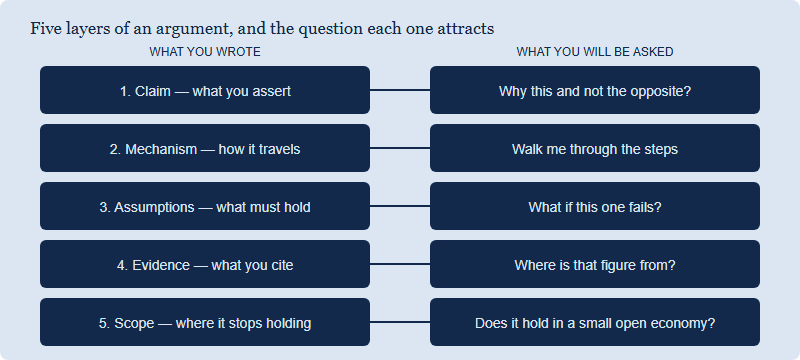
Every economic argument is a claim plus a mechanism plus a set of assumptions that must hold for the mechanism to work. Students write the claim and the mechanism. They rarely write the assumptions, because in a written answer nothing forces them to.
The audit is mechanical. Take your finished answer and, line by line, ask: what would have to be true for this sentence to be correct? Write each answer down as a separate numbered assumption. An answer of this kind typically generates between six and twelve. Then rank them by fragility — how plausible is it that a well-informed sceptic could argue this one fails?
The top two or three on that list are where you will be questioned. Not because anyone can read your mind, but because a competent examiner is running the same audit you just ran, and arriving at the same weak points. Having already found them, you are answering a question you have thought about rather than one that ambushes you.
The audit also protects you from the most common defence failure, which is over-claiming. Once you have written “this assumes the demand response is not fully offset in the short run”, you will stop saying “this will reduce consumption” and start saying “this reduces consumption provided the demand response is not fully offset”. That second sentence is much harder to attack, and it costs you nothing.
Four kinds of challenge, and what each is really testing
Questions put to an economics argument come in a small number of shapes. Recognising the shape tells you what a good answer looks like, and — just as usefully — tells you when a question is not the attack it sounds like.
| Challenge | Sounds like | What it is testing | Response structure | Failure mode |
|---|---|---|---|---|
| The counter-case | “But what about a country where the opposite happened?” | Whether you know the boundary of your own claim | Accept the case, then state the condition that distinguishes it from yours | Denying the counter-case exists |
| The assumption pull | “You assumed X. Why?” | Whether you knew you assumed it | Name it, justify why it is reasonable here, say what changes if it fails | Discovering the assumption live and improvising |
| The mechanism probe | “How exactly does that reach households?” | Whether the chain has a missing link | Say the steps in order, out loud, one clause each | Jumping from cause straight to conclusion |
| The magnitude test | “Is that effect big enough to matter?” | Whether you can distinguish direction from size | Concede that direction is clearer than size, then give the factors that scale it | Asserting a number you cannot source |
The magnitude test deserves particular attention because it is where strong students most often overreach. Economic theory usually gives you a confident answer about direction and a much weaker answer about size. Saying “theory tells us the sign; the magnitude depends on elasticity, on how much of the market is exposed, and on the time horizon” is a better answer than any invented figure, and it demonstrates exactly the judgement being assessed.
The concession that strengthens your position
The instinct under questioning is to defend everything. It is the wrong instinct, and it is visible immediately.
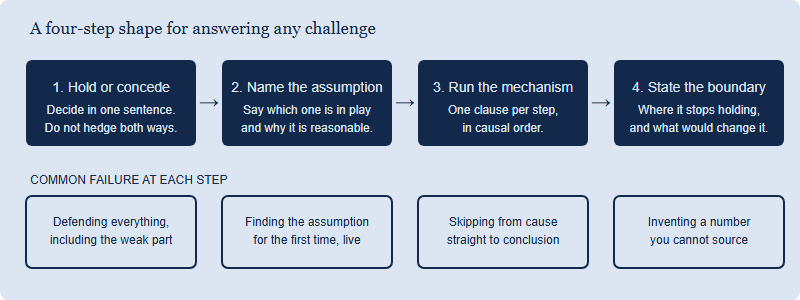
A defence is not a debate you win by holding every inch of ground. It is a demonstration that you understand your own argument, including its limits. When a fair point lands, the strongest available move is to take it: “That is right, and it is the weakest link in what we wrote. Here is why we still think the conclusion holds, and here is what would change our mind.” That answer shows you can distinguish a survivable objection from a fatal one — which is a more advanced skill than never being objected to.
What to avoid is the opposite failure: conceding so broadly that your conclusion evaporates. The discipline is to concede the specific point and immediately re-anchor: what still stands, and why. Concede the fact, keep the claim.
There is also an honest way to say you do not know. “I do not have that figure. What I can tell you is which direction it should run and what would make it larger.” That is a complete answer. Silence is not, and neither is a guessed number — a fabricated statistic is the one error from which an argument does not recover.
Who answers what: allocating the defence across a team
In the divisions that require a full team, an unallocated defence produces one of two bad outcomes: everybody answers at once, or one person answers everything while three sit silent. Both read badly and both are avoidable with fifteen minutes of planning.
- Assign by argument, not by topic. Whoever built a section of the reasoning owns questions about it. Topic-based allocation breaks down immediately, because real questions cut across micro, macro and world economy at once.
- Name a first responder. One person takes the opening sentence of every answer — usually the hold-or-concede decision — then hands to the owner. This removes the two-second silence where nobody knows who speaks.
- Agree a hand-off phrase. Something plain: “that is the labour-market side of it, which is where my teammate built the argument.” It is smoother than it sounds and it stops interruptions.
- Rehearse being interrupted. In practice runs, have someone cut in halfway. Teams that have never experienced this lose the thread; teams that have simply finish the clause and answer.
- Decide who says “we do not know”. One voice, one agreed formulation. Four people improvising an admission of uncertainty sounds far worse than one person stating it cleanly.
Division rules differ, including team-size requirements — the advanced track has its own expectations, which we set out in our guide to the Adam Smith division. Confirm current team rules for your division on the official CNEC channels.
A four-week rehearsal that actually builds the skill
You cannot practise defending in the abstract. You need a real argument, and someone willing to attack it.
Week one — audit. Take a completed answer. List every assumption. Rank by fragility. No talking yet; this week is entirely on paper.
Week two — cold questions. A teammate or teacher reads only your submitted answer and writes eight questions. You answer them aloud, unprepared, and record yourself. The recording is the point: you will hear the filler, the over-claiming and the hesitation more clearly than you feel them.
Week three — the hostile pass. Someone plays a genuine sceptic who wants your conclusion to be wrong. This is where you practise conceding a fair point without collapsing. Expect the first attempt to go badly.
Week four — full run with hand-offs. Whole team, no notes, interruptions permitted, timed. Then swap: your team attacks another team's answer. Attacking teaches you more about defending than any amount of defending does, because you finally see how obvious the weak assumption looks from the outside.
One coaching observation worth passing on, from a colleague who has judged at the NEC China final across multiple seasons: the difference between a competent answer and a distinguished one is usually audible in the first fifteen seconds. Teams that open with a clear position and a named assumption sound different from teams that reason towards a position while talking. Both may reach the same place. Only one sounds like it knew where it was going.
If you are weighing this kind of work against the written economics essay competitions, the defence stage is one of the sharpest differences between the formats — a comparison we make in NEC versus the economics essay prizes.
Is there always a defence stage in NEC?
Stages and eligibility are set by the competition and vary by division and season. Confirm what applies to your entry on the official CNEC channels.
What should I say if I do not know a figure?
Say you do not have it, then give the direction the effect should run and what would make it larger. Never invent a statistic.
Does conceding a point weaken our answer?
No. Conceding a specific fact while re-anchoring your conclusion shows you know your argument's limits, which is what is being assessed.
How do we stop everyone answering at once?
Name one first responder for the opening sentence of every answer, then hand to whoever built that part of the argument.
Published by the NEC (CNEC) editorial desk, operated by Hanlin Education for China-based international-school students. Official rules are set by the competition and change yearly — confirm current details on councilforeconed.org. Errors are corrected within 7 working days.