
If you take AP Micro, AP Macro or A-Level Economics, most of NEC's microeconomic and macroeconomic content is already on your syllabus. Three things are not: the world-economy strand, the demand to hold micro and macro simultaneously in one sitting, and the speed-and-team format. Those three gaps — not the economics itself — are what usually decides how a first-time team performs.
The Council for Economic Education names your course explicitly
Start with what the organiser actually says, because it settles a question students spend a lot of time guessing at. The Council for Economic Education describes its two named divisions as follows: the David Ricardo Division is “for students participating in the NEC for the first time and who have taken no more than one economics course”, while the Adam Smith Division is “for advanced placement, baccalaureate, honors students, and returning competitors”.
Read that carefully. Advanced Placement students are named in the description of the advanced division. If you have completed AP Micro and AP Macro, or a full A-Level Economics course, you are the profile that division description points at — not because the competition is harder than your course, but because you arrive with a stock of content the entry-level division does not assume.
Two cautions before you act on that. First, these are the division descriptions published for the US-side competition; criteria as they apply to the China national round are set by the organiser and can differ, so confirm which definition governs your entry before you commit to a division. Second, “returning competitors” sits in the same sentence — meaning the advanced field contains teams that have done the format before, which is a different advantage from content knowledge. We unpack that trade-off in our guide to the Adam Smith division.
What your syllabus already gives you
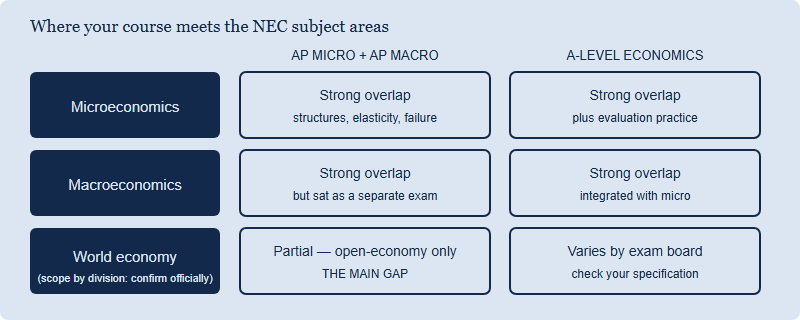
NEC assesses, in the CEE's wording, “key micro and macroeconomic principles, as well as their knowledge of the world economy”. Which subject areas apply to each division, including the China-side Pre division, is set by the organiser — confirm this for your division on the official CNEC channels.
Against that, a full AP or A-Level course is a substantial head start on two of the three areas. The microeconomic core — supply and demand, elasticity, market structures, costs and revenues, market failure, government intervention — maps closely in both systems. The macroeconomic core — aggregate demand and supply, inflation, unemployment, fiscal and monetary policy — likewise. You are not starting from zero on roughly two-thirds of the assessed material, and you should not revise as though you were.
Where the two routes differ is in habit rather than content. AP Economics trains you to work quickly through multiple-choice items and produce compact free-response answers with diagrams. A-Level trains you to write extended evaluative answers with weighed arguments. The AP habit transfers more directly to NEC's test-style rounds; the A-Level habit transfers more directly to the open-ended reasoning rounds. Each route is strong where the other is thinner, which is worth knowing before you decide what to practise.
Gap one: the world economy is the strand your course covers least
This is the gap that most often surprises strong students. The international strand is not an extension of macroeconomics — it has its own vocabulary, its own accounting identities and its own set of standard results.
An AP route gives you an open-economy component within Macro, and that component is genuinely useful: exchange rates, the loanable-funds link, the basic balance-of-payments idea. What it does not do is give you the depth that a dedicated international strand assumes. A-Level specifications generally include international trade and the global economy, but the weight and the depth vary by board and route, so “A-Level covers it” is not a safe assumption — check your own specification rather than a general claim about the qualification.
The practical test is simple. Can you, without notes, explain comparative advantage with a numerical example; state what the current account and financial account must sum to and why; explain how a depreciation affects trade volumes and over what horizon; and describe why a tariff and a quota have different revenue implications? If any of those four is shaky, that is where your preparation hours belong. Note also that the world-economy strand applies to the divisions above Pre — which subject areas apply to your division is set by the organiser — confirm it on the official CNEC channels.
Gap two: your course never asks for all three at once
AP Economics is structured as two separate courses with two separate exams. You revise Micro, sit Micro, revise Macro, sit Macro. At no point does either exam ask you to switch between a cost-curve question and a balance-of-payments question in consecutive items.
NEC does exactly that. The difficulty is not that any individual question is harder than an AP item — often it is not. The difficulty is switching cost. Every time you move between subject areas you reload a different mental model, and under time pressure that reload is where the errors appear: applying a partial-equilibrium instinct to a macro question, or reaching for a domestic-market intuition on an open-economy one.
A-Level students carry less of this problem, because the qualification integrates micro and macro across papers. What A-Level students more often carry instead is a pacing problem: extended evaluative writing rewards deliberation, and several NEC rounds reward speed.
The fix for both is the same and it is unglamorous. Practise mixed material only. Once your content foundation is in place, stop revising one topic at a time — every practice session should shuffle micro, macro and world-economy items so that switching becomes routine rather than costly.
Gap three: nothing in your course is a team format
Your school exams are individual and silent. Several NEC rounds are neither. Per the CNEC organising team’s 2027 outline, the competition runs the Qualifying Test, Critical Thinking and the Quiz Bowl, with the OX-BP Debate Sessions and U20 Youth Voice added at the global round — and they do not all reward the same capability. A student who is excellent at written accuracy can be genuinely mediocre at buzzer-speed retrieval, and vice versa. We break down what each round asks in the NEC rounds, explained.
Team-size requirements differ by division and are set by the organiser — confirm the current rules for your division on the official CNEC channels before you build a team around an assumption.
| Gap | Why your course leaves it | Symptom in practice | Fix |
|---|---|---|---|
| World-economy depth | AP covers open-economy macro only; A-Level weighting varies by board | Confident on domestic policy, vague on trade balances and exchange-rate transmission | Two weeks dedicated solely to the international strand, before any mixed practice |
| Subject switching | AP splits Micro and Macro into separate exams | Errors cluster at the point where question type changes, not on hard questions | Shuffled practice sets only; never revise one topic in isolation after week two |
| Speed and retrieval | School exams reward deliberation, not recall under a buzzer | You know the term but cannot produce it in under three seconds | Timed cold-recall drills on definitions; separate this from comprehension work |
| Team coordination | All school assessment is individual | Two people answer at once, or nobody does | Allocate subject ownership and rehearse hand-offs before the first live round |
| Vocabulary in English | Terms learned in one language do not always retrieve fast in another | Recognition is fine; production under time pressure is slow | Drill production, not recognition — define the term aloud from a blank prompt |
An eight-week sequence that closes the gaps in order
Order matters here. Closing the content gap before drilling speed is not a preference; drilling retrieval on material you have not yet learned properly just makes you fast at being wrong.
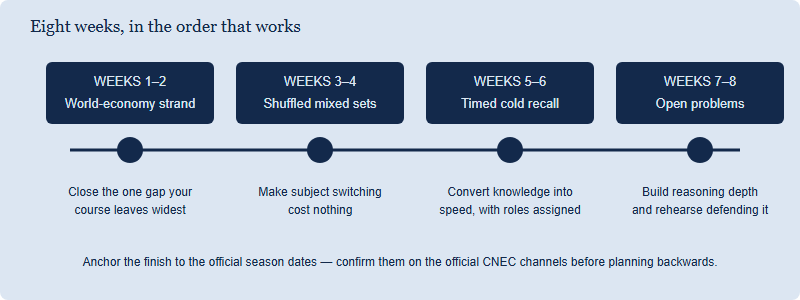
Two notes on running it. Keep an error log sorted by topic, not by paper — the pattern you are hunting is a recurring weakness, and paper-by-paper marking hides it. And treat weeks five to eight as team work rather than individual work; retrieval speed and reasoning depth are both trained faster with someone else in the room asking the questions.
Which division should a course-trained student enter?
The honest answer is that division criteria decide this, not preference. The CEE's own descriptions turn on prior economics study and prior participation, and the criteria applied to the China national round are set by the organiser. Confirm which definition governs your entry before choosing.
Within whatever the rules permit, the useful question is where the marginal hour of work still changes your placing. A student with two AP Economics courses behind them who enters a field of first-time competitors will find the content undemanding and learn relatively little; the same student in the advanced field will be tested on exactly the capabilities their course did not build. The second is the more useful year, even if the placing is worse.
One framing to avoid: treating NEC as a credential. The organising committee positions CNEC as a professional social-practice activity rather than something tied to domestic school admission, and it should be chosen for what it teaches. If you are also weighing the written economics essay competitions, the two formats reward genuinely different skills — a comparison we set out in NEC versus the economics essay prizes.
Does the CEE mention AP students in its division descriptions?
Yes. It describes the Adam Smith Division as being for “advanced placement, baccalaureate, honors students, and returning competitors”.
Which NEC area does AP Economics cover least?
The world economy. AP gives you open-economy macro, but not the depth a dedicated international strand assumes.
Does A-Level Economics cover the international strand?
Coverage and weighting vary by exam board and route. Check your own specification rather than assuming the qualification covers it.
Can A-Level or AP students enter the Adam Smith division?
Division criteria are set by the organiser and differ between the US and China rounds. Confirm the rules for your entry officially.
Published by the NEC (CNEC) editorial desk, operated by Hanlin Education for China-based international-school students. Official rules are set by the competition and change yearly — confirm current details on councilforeconed.org. Errors are corrected within 7 working days.