Teaching illustration: The following examples are original teaching material designed to illustrate a common calculation pitfall in economics. They are not official NEC past-paper questions, marking criteria, or confirmed competition content. No source document provided to this editorial process contains any elasticity content; all elasticity methodology discussed below is general economics pedagogy.
For students preparing for the National Economics Challenge (NEC), elasticity questions in the DR or AS divisions can trip up even those who know the formula. Price Elasticity of Demand (PED) is the percentage change in quantity demanded divided by the percentage change in price. Yet the denominator—the base used to calculate each percentage change—determines whether your answer matches the expected response. This article focuses on a single, narrow skill: selecting the appropriate base before you compare percentage changes across scenarios.
Why Base Selection Creates Confusion
Percentage change is not uniquely defined. If a price rises from 100, you might calculate the change as (100 − 80) / 80 = 25%. If the price then falls back from 80, the same magnitude change becomes (80 − 100) / 100 = −20%. The direction of movement alters the percentage because the base changes. In economics competitions, this asymmetry matters when questions ask about elasticity over a range rather than at a single point.
Teaching Illustration 1: Directional Asymmetry With an Initial Base
Consider a hypothetical textbook market where price falls from 80 and quantity demanded rises from 50 to 70 units.
- Using the initial value as base for the price decrease: %ΔQ = (70 − 50) / 50 = +40%; %ΔP = (80 − 100) / 100 = −20%; PED = 40% / −20% = −2.0 (absolute value 2.0).
- Now reverse the direction: price rises from 100, quantity falls from 70 to 50. %ΔQ = (50 − 70) / 70 ≈ −28.57%; %ΔP = (100 − 80) / 80 = +25%; PED = −28.57% / 25% ≈ −1.14 (absolute value 1.14).
The same price-quantity pair yields two different elasticity magnitudes depending solely on which direction you move. This inconsistency means an initial-base approach cannot reliably classify whether demand over this range is elastic or inelastic.
Teaching Illustration 2: The Midpoint Method for Symmetry
The midpoint method uses the average of initial and final values as the base for each percentage change. The formula is:
PED = [(Q₂ − Q₁) / ((Q₁ + Q₂)/2)] ÷ [(P₂ − P₁) / ((P₁ + P₂)/2)]
Applying this to the same hypothetical data:
- Quantity component: (70 − 50) / ((50 + 70)/2) = 20 / 60 ≈ +33.33%
- Price component: (80 − 100) / ((100 + 80)/2) = −20 / 90 ≈ −22.22%
- PED = 33.33% / −22.22% ≈ −1.5 (absolute value 1.5)
Reversing the direction—price from 100, quantity from 70 to 50—yields identical components with opposite signs, producing the same absolute value of 1.5. The midpoint method eliminates directional bias.
Choosing the Base: A Decision Framework for NEC Preparation
The following framework provides explicit selection criteria. It is based on standard economics pedagogy, not on NEC-specific marking guidance, because no source document in this editorial process contains elasticity content.
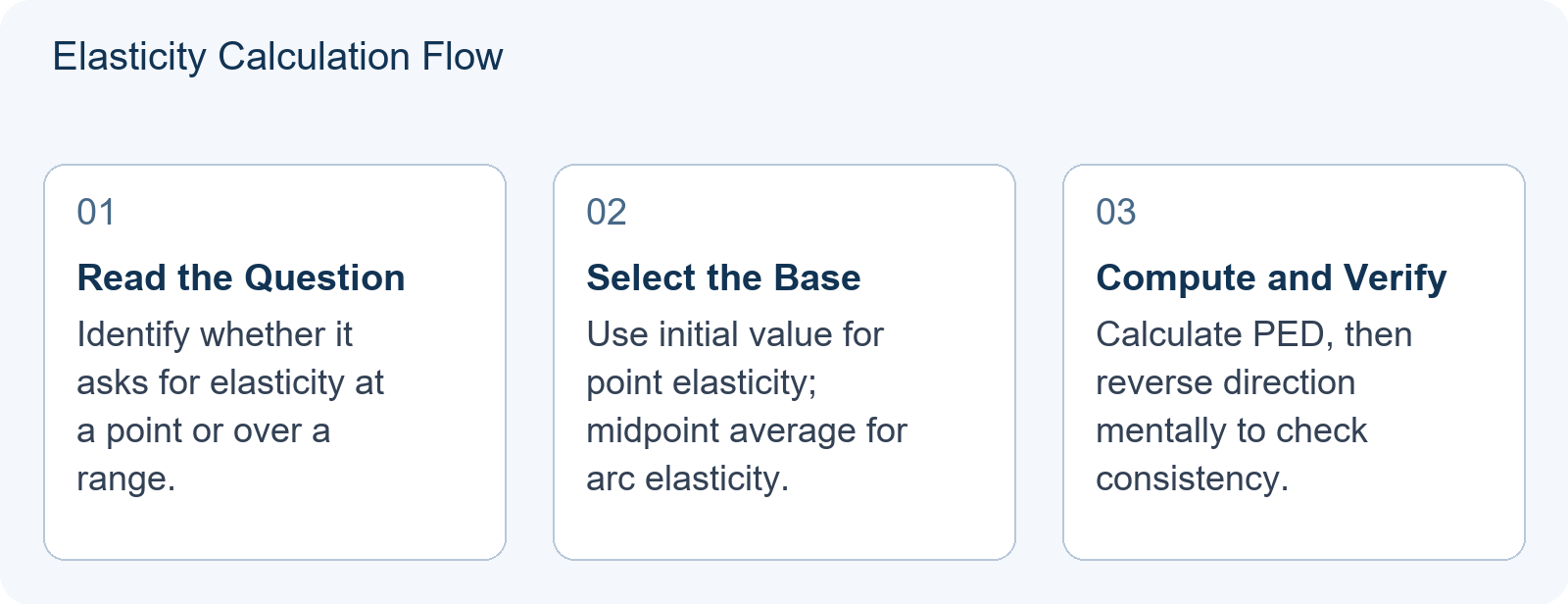
Step 1: Identify the Question Structure
Read the question wording carefully before calculating:
- Point elasticity: Questions that ask “at a price of $X” or “at point A on the demand curve” require using the initial value at that point, or the derivative if a function is given.
- Arc elasticity: Questions that ask “between point A and point B” or “over this price range” require the midpoint method for a consistent single value.
- Directional change specified: Questions that state “when price rises from Y” may intend initial-base calculation; check whether answer options align with one method or the other.
Step 2: Match Method to Division Level
While NEC does not publish explicit method preferences, the following pattern reflects standard economics pedagogy at different preparation levels:
- Pre Division: Focus on conceptual understanding; calculations typically use simple percentage changes with clear directional wording.
- DR Division: Introduces arc elasticity; midpoint method becomes relevant for range-based questions in multiple-choice formats.
- AS Division: Requires rapid identification of which method applies based on question wording alone; mixed practice essential.
Step 3: Verify Consistency
After selecting a method, perform a consistency check:
- Calculate elasticity using your chosen base.
- Mentally reverse the direction of change (swap start and end points).
- If the absolute value changes, your base choice is inconsistent for range questions.
- For range questions, the midpoint method should yield identical absolute values regardless of direction.
Diagnostic Table: Selecting Your Base
| Question Wording | Base to Use | Rationale |
|---|---|---|
| “At a price of $X…” or “At point A…” | Point elasticity (initial value or derivative) | Measures responsiveness at a specific location on the curve. |
| “Between point A and point B…” or “Over this range…” | Midpoint (average of endpoints) | Ensures a single consistent value regardless of direction. |
| “When price rises from Y…” | Check answer options carefully | May intend initial base; if both methods appear in options, midpoint is technically preferred for arc elasticity. |
Common Error Pattern and Self-Check
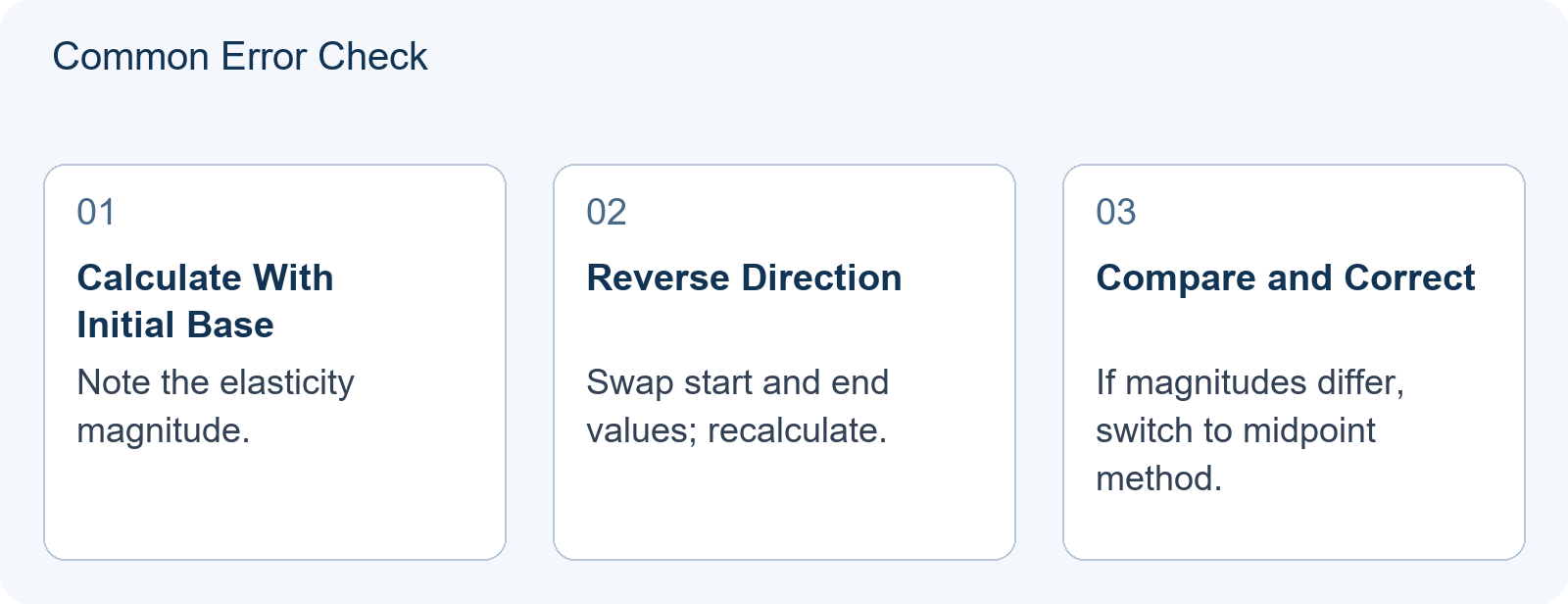
A frequent mistake is applying initial-base percentages to range-based questions. To self-diagnose:
- Calculate elasticity using your chosen base.
- Swap the start and end points mentally and recalculate.
- If the absolute value changes, your base choice is inconsistent for range questions.
- Recompute with the midpoint method and compare to answer choices.
Connecting to Broader NEC Preparation
Elasticity calculations feed into multiple NEC topic areas. Understanding base selection helps when analyzing how price changes affect consumer surplus, how tariffs alter quantities traded, or how exchange-rate movements influence trade balances. For students building from micro foundations toward macro applications, consistent calculation discipline prevents cascading errors in multi-step problems.
Related site resources include coverage of NEC Global Round Singapore 2027: What the New Asia Stop Actually Adds to Your Calendar, which discusses calendar planning for competition season; NEC Herbert Simon Division AI Track: Deciding Whether It Fits Your Team, for division selection guidance; and NEC Pre Division Personal Entry: Should You Compete Solo or Wait for a Team in 2027, for entry-mode decisions.
Skill Demonstration Checklist
Before relying on this technique in competition settings, verify you can:
- Distinguish point elasticity from arc elasticity from question wording alone.
- Compute midpoint-based percentage changes without formula errors.
- Classify results correctly: elastic if |PED| > 1, inelastic if |PED| < 1, unit elastic if |PED| = 1.
- Explain why initial-base methods fail for range comparisons.
This narrow focus on base selection addresses a specific calculation failure mode. It does not replace broader elasticity theory—PED sign conventions, determinants of elasticity, or welfare analysis—but targets the precise moment where mechanical execution determines whether theoretical knowledge produces correct numerical answers.
Frequently Asked Questions
Does NEC prefer the midpoint method for all elasticity questions?
No source document confirms NEC preferences for elasticity methods. Point elasticity at a specific price typically uses the initial value or derivative. Arc elasticity over a range uses the midpoint method for consistency. The question wording indicates which approach applies.
Why do initial-base calculations give different results for the same range?
Because the denominator changes. A rise from 100 uses 100 to 100. The midpoint method fixes the base at the average, removing this directional dependence.
How can I practice recognizing which base to use under time pressure?
Drill on question wording: ‘at a price of’ signals point elasticity; ‘between’ or ‘over the range’ signals arc elasticity. Calculate both methods when practicing, then verify which answer choice matches your technically correct method.