
In the National Economics Challenge (NEC), exchange-rate questions in the world-economy section test one core skill: can you treat a currency like any other good with a supply-and-demand market, predict whether it will appreciate or depreciate when that market shifts, and then trace the effect on exports and imports? This guide drills exactly that mechanics layer — not regimes, not the balance of payments — so you can read an FX scenario in seconds.
A currency is just a good with a market
The NEC, run by the Council for Economic Education (CEE, founded 1949), covers microeconomics, macroeconomics and the world/international economy, and reaches roughly 10,000 students a year in the United States. The single most reliable way to unlock its currency questions is to notice that an exchange rate is a price, and like every price it is set where supply meets demand. The only twist is that the “good” being priced is one country's money, quoted in terms of another's.
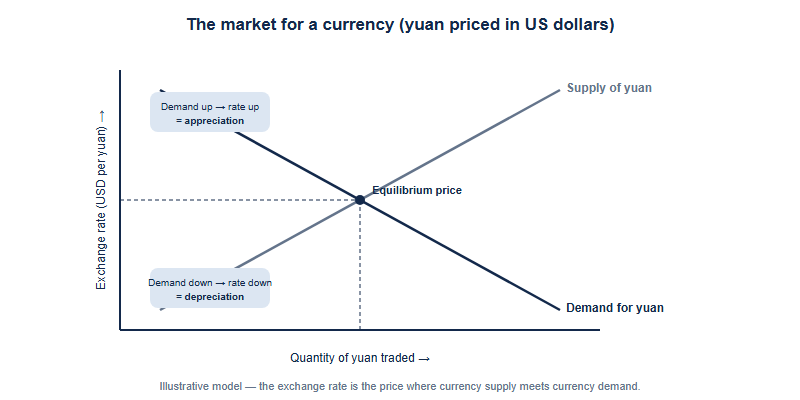
Take the price of the Chinese yuan in US dollars. Demand for yuan comes from anyone who needs yuan to complete a transaction: foreigners buying Chinese exports, tourists visiting China, and investors moving money into Chinese assets. Supply of yuan comes from anyone offering yuan to get another currency instead: Chinese importers paying for foreign goods, Chinese tourists going abroad, and domestic investors buying foreign assets. When demand for yuan rises or its supply falls, the yuan's price rises — it appreciates. When demand falls or supply rises, the yuan's price falls — it depreciates. That is the whole engine, and almost every FX question is a disguised version of it.
Appreciation vs depreciation: getting the direction right
The most common mistake on NEC currency questions is mixing up the two words and the direction they imply. Keep the definitions clean. A currency appreciates when its value rises against another currency — one yuan buys more dollars than before, or equivalently it takes more dollars to buy one yuan. A currency depreciates when its value falls — one yuan buys fewer dollars. Crucially, appreciation and depreciation are always relative: if the yuan appreciates against the dollar, the dollar by definition depreciates against the yuan. There is no such thing as a one-sided move; every exchange-rate change is a statement about a pair.
A clean test-day habit is to rewrite the rate as “units of A per unit of B” before you reason. If the question quotes US dollars per yuan and that number goes up, the yuan has appreciated. If it goes down, the yuan has depreciated. Anchoring to a single quoting convention removes most of the confusion that costs marks. Watch the wording too: a currency that “strengthens,” “gains” or “rises” has appreciated; one that “weakens,” “slides” or “falls” has depreciated.
| Term | What it means for the yuan | USD-per-yuan quote | Mirror effect on the dollar |
|---|---|---|---|
| Appreciation | Yuan worth more; buys more dollars | Number rises (e.g. 0.14 → 0.15) | Dollar depreciates vs yuan |
| Depreciation | Yuan worth less; buys fewer dollars | Number falls (e.g. 0.14 → 0.13) | Dollar appreciates vs yuan |
The numbers above are illustrative, chosen only to show direction — never quote a real exchange rate from memory in a timed answer unless the question gives it. What the marker rewards is the correct direction and the correct pairing, not a fabricated figure.
Why the direction matters: appreciation, depreciation and trade
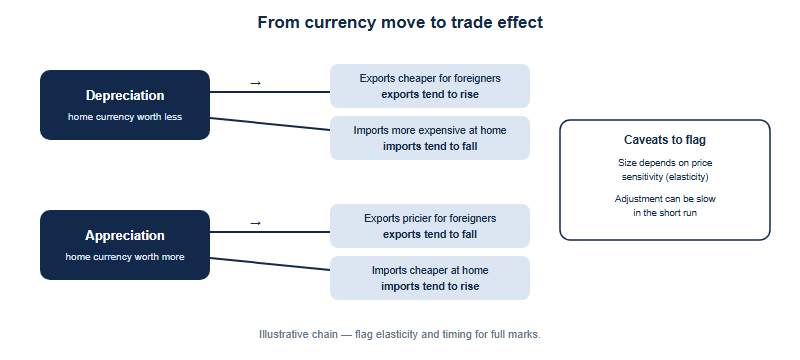
An exchange-rate move is only interesting because it changes the prices of exports and imports, and this is the second half of nearly every NEC currency question. When a currency depreciates, that country's exports become cheaper for foreign buyers (their money now buys more of your currency), while its imports become more expensive (your money buys less foreign currency). So a depreciation tends to support exports and raise the cost of imports. When a currency appreciates, the logic flips: exports look more expensive abroad and imports become cheaper at home, which tends to dampen exports and cheapen imports.
A concrete way to remember it: imagine a Chinese exporter selling a product priced in yuan. If the yuan depreciates, a US buyer paying in dollars now needs fewer dollars to cover the same yuan price — the product effectively got cheaper for them, so they buy more. Meanwhile a Chinese family eyeing an imported foreign gadget finds it pricier, because their yuan now buys less foreign currency. That single mental picture — one exporter, one importer — lets you derive the trade effects of any move instead of memorising a table. The standard caveat the NEC expects you to flag is that these effects depend on how responsive buyers are to price (price elasticity) and may take time to appear; in the very short run, trade volumes can be slow to adjust.
Reading an FX scenario in four steps
NEC scenario questions rarely ask “define depreciation.” They describe an event — a surge in foreign demand for a country's exports, a wave of investors moving capital in or out, a jump in tourism — and ask what happens to the exchange rate and to trade. A repeatable four-step routine turns any of these into a confident answer, and it works whether the round is multiple-choice, a buzzer question or a written round.
- Step 1 — Name the currency and the quote. Decide which currency the question is really about and fix the convention (e.g. dollars per yuan), so “up” and “down” are unambiguous.
- Step 2 — Find the curve that shifts. Ask whether the event changes demand for that currency or its supply. Foreigners wanting more of it, or capital flowing in, shifts demand right; locals sending money out, or capital flowing out, shifts supply right.
- Step 3 — Read the new price. A rightward demand shift or leftward supply shift raises the price — appreciation. A leftward demand shift or rightward supply shift lowers it — depreciation.
- Step 4 — Trace the trade effect. Apply the export-import rule: depreciation supports exports and raises import costs; appreciation does the reverse. Add the elasticity-and-timing caveat if the answer format allows.
Worked example: “Foreign investors sharply increase purchases of a country's government bonds. What happens to its currency and its exports?” Step 1, the currency is the bond issuer's. Step 2, foreign investors need that currency to buy the bonds, so demand shifts right. Step 3, demand up means the currency appreciates. Step 4, an appreciation makes exports more expensive abroad, so exports tend to fall, all else equal. Four steps, no guesswork, no invented numbers. If you want to see where world-economy material like this sits in the wider syllabus, the structure is laid out on the CNEC home page, and the world-economy strand is one of the three subject areas the NEC always tests.
A first-party note from the CNEC desk
As the officially authorized China test center for the NEC, the recurring pattern we see in practice rounds is that students lose exchange-rate marks not because the economics is hard, but because they skip Step 1 and argue about “up” and “down” without fixing the quote. The teams that score well slow down for one second to name the currency and the convention, then let the supply-and-demand engine do the rest. Two habits pay off most: rewrite every rate as “units of A per unit of B” before reasoning, and always finish a currency answer with its trade consequence plus the elasticity-and-timing caveat — markers reward the full chain, not just the direction.
A standing reminder on facts: this article teaches the FX mechanics the world-economy section tests, which are stable economics. Anything competition-specific — the exact rounds in which currency questions appear, the weighting, the format for a given cycle — is set by the organiser and changes year to year, so confirm it on the official channels. The CEE sets the underlying academic standard for the NEC; the CNEC desk runs the China round. For the route from China onward, the CNEC is the official China National Round, operated by Hanlin (SKT) since 2016 across 20+ provinces and 300+ schools, and it is the only official path from China to the NEC global rounds. You can review the official details on the official CNEC site; any named question-setters or judges cited elsewhere are organiser claims to confirm officially, never to assert as fact.
Frequently asked questions
What is the difference between appreciation and depreciation?
Appreciation means a currency rises in value against another; depreciation means it falls. They are always relative — if one appreciates, the paired currency depreciates.
Does a depreciation help or hurt exports?
A depreciation makes exports cheaper for foreign buyers, so it tends to support exports, while making imports more expensive at home. Effects depend on price sensitivity and timing.
How do I tell if a currency appreciated from a quote?
Fix the convention, such as dollars per yuan. If that number rises, the yuan appreciated; if it falls, it depreciated. Anchoring to one quote prevents direction errors.
Do NEC exchange-rate questions need real exchange-rate figures?
No. They reward the correct direction and trade effect from supply and demand. Never invent a real rate; use only figures the question provides.
Published by the NEC / CNEC editorial desk, operated by Hanlin Education as the officially authorized China National Economics Challenge (CNEC) test center. The NEC is run by the Council for Economic Education, which sets the official rules — always confirm current dates, divisions, fees and awards on the official CNEC channels. Any errors will be corrected within 7 working days.