
On the National Economics Challenge (NEC), factor markets flip the question students drill in product markets: instead of asking what a firm sells, you ask what it buys. The core idea is that a firm hires labor and other inputs up to the point where the last unit's marginal revenue product equals its marginal cost. Master that single rule and the rest — why labor demand is derived, how wages settle, and how rent and interest fit — falls into place.
Why factor markets sit inside NEC microeconomics
The NEC is run by the Council for Economic Education (CEE), founded in 1949, which sets the academic standard the contest is built on. Its three subject pillars are microeconomics, macroeconomics and world / international economy. Factor markets — the markets for labor, land, and capital — live inside the micro pillar, and they matter because they answer a question product-market analysis never does: how is income distributed? Wages, rent, interest and profit are all factor payments, and the same supply-and-demand logic that prices a good also prices an hour of work.
For students entering through CNEC — the official China National Round operated by Hanlin (SKT) since 2016, and the only official path from China to the NEC global rounds — factor markets are where careful candidates pull ahead. The topic feels abstract at first, but it rewards a mechanical habit: every factor-demand question is a hiring decision, and every hiring decision obeys one comparison. You can review how the wider contest is organised on the CNEC homepage.
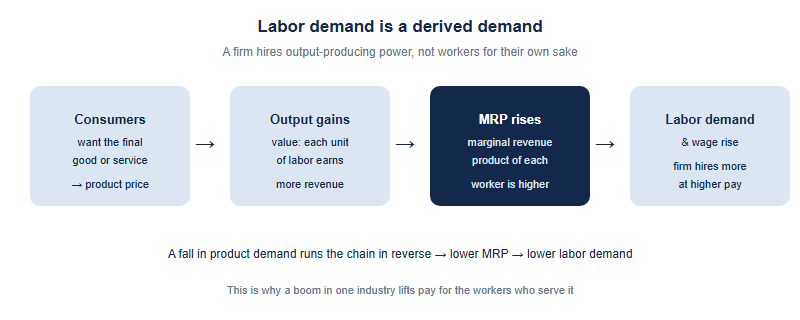
The crucial conceptual move — the one NEC prompts test again and again — is that the demand for any input is a derived demand. A firm does not want workers for their own sake; it wants the output those workers produce and the revenue that output earns. So labor demand rises and falls with the demand for the final product. When the price of the good a worker makes goes up, the demand for that worker goes up too, even if nothing about the worker changes.
Marginal revenue product: the firm's hiring rule
If labor demand is derived from output value, then the precise measure of what a worker is worth to a firm is the marginal revenue product (MRP) — the extra revenue the firm earns from hiring one more unit of labor. It has two ingredients multiplied together:
- Marginal product (MP): the extra output one more worker produces. This is a physical, technological fact about production.
- Marginal revenue (MR) per unit of output: the extra revenue each of those units brings in. In a competitive output market this equals the product price, so MRP is sometimes called the value of the marginal product.
Put simply, MRP = MP × MR (in a competitive product market, MRP = MP × price). The firm then weighs that against what the extra worker costs — the marginal resource cost (MRC), which in a competitive labor market is just the wage. The hiring rule NEC rewards is the factor-market twin of the output rule: hire up to the point where MRP = MRC. If the next worker's MRP exceeds the wage, hiring adds profit; if it falls short, the firm has hired one too many.
Crucially, MRP declines as more workers are added, because of the law of diminishing marginal returns: with fixed capital, each additional worker eventually adds less extra output than the one before. That downward slope is exactly why the firm's labor-demand curve slopes down — the MRP curve is the firm's demand-for-labor curve. A worked example makes the rule concrete:
| Workers | Total output | Marginal product (MP) | MRP at $10 price | Hire if wage = $50? |
|---|---|---|---|---|
| 1 | 10 | 10 | $100 | Yes (MRP > wage) |
| 2 | 19 | 9 | $90 | Yes |
| 3 | 26 | 7 | $70 | Yes |
| 4 | 31 | 5 | $50 | Yes — the last worth hiring |
| 5 | 34 | 3 | $30 | No (MRP < wage) |
The table is illustrative — the numbers are chosen to show the logic, not drawn from any official paper — but the pattern is exactly what NEC tests. At a wage of $50 the firm hires four workers, because the fourth's MRP ($50) just covers the wage and the fifth's ($30) does not. Change the wage and the firm slides along its MRP curve; change the product price and the whole MRP curve shifts, moving labor demand. Strong candidates can state, from a table like this, both how many to hire and why the curve would shift.
Wage determination: where labor supply meets labor demand
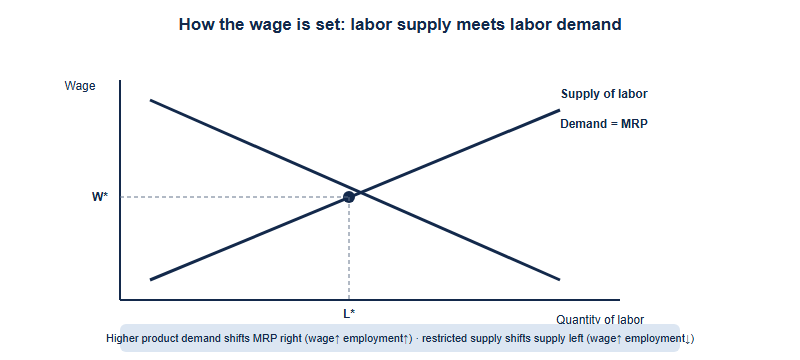
A single firm's MRP curve explains its own hiring, but the wage itself is set in the wider labor market, where the demand for labor (the sum of firms' MRP curves) meets the supply of labor. Labor supply slopes upward because higher wages draw more people into the market and encourage longer hours. NEC questions ask you to find the equilibrium wage and employment, then predict how shifts move them.
Two market settings recur, and the distinction is a frequent source of marks:
- Competitive labor market: many firms and many workers, no single actor sets the wage. Each firm is a wage taker — it can hire all the labor it wants at the going wage, so MRC equals the wage, and it hires where MRP = wage. The market wage is whatever clears total supply and demand.
- Monopsony (single buyer of labor): when one employer dominates a local labor market, it faces the upward-sloping market supply curve directly. To hire more it must raise the wage for everyone, so its MRC exceeds the wage. The result NEC rewards: a monopsonist hires fewer workers at a lower wage than a competitive market would — the mirror image of a monopoly in the product market.
From this framework, several real-world results follow that NEC likes to probe. Why do surgeons earn more than cleaners? High MRP (skill and the value of their output) meets low, inelastic supply (long training restricts entry). What raises wages over time? Anything that lifts MRP — better technology, more capital per worker, rising demand for the final product — or anything that restricts supply, such as licensing. A minimum wage set above equilibrium is the classic application: in a competitive market it can create unemployment (a surplus of labor), but in a monopsony it can raise both wages and employment, because it stops the single buyer from suppressing the wage. That nuance — same policy, opposite effect depending on market structure — is exactly the trade-off graders look for.
Beyond labor: rent and interest as factor payments
Labor is the factor NEC tests most, but the same logic extends to the other inputs, and a question can pivot to land or capital without warning. The unifying idea is that every factor earns a payment determined by its supply and the demand derived from its productivity.
- Economic rent (the return to land): land's defining feature is that its total supply is broadly fixed — perfectly inelastic. Because supply cannot expand when demand rises, the entire adjustment shows up in price: the rent is demand-determined. This is why a surge in demand for a prime location raises its rent sharply while the quantity of land stays put. More generally, economic rent is any payment to a factor above what is needed to keep it in its current use.
- Interest (the return to capital): interest is the price of borrowing funds, set in the market for loanable funds where saving (supply) meets investment and borrowing (demand). A firm undertakes an investment when its expected return clears the interest rate — the same marginal comparison as the labor rule, applied to capital. Interest also reflects the time value of money: a sum today is worth more than the same sum later, which is why future returns are discounted.
A clean way to hold the three factors together for the exam: each earns a payment (wages, rent, interest), each is demanded for what it produces, and the elasticity of its supply decides how a demand change splits between price and quantity. Labor supply is fairly responsive; land supply is fixed; capital supply runs through saving and the interest rate. Note the discipline that runs through every factor-market answer: when a prompt does not give you a number, you reason from the curves and state your assumption rather than inventing a figure — and the same applies to the contest's own rules. Eligibility, divisions, rounds, dates, fees and awards are set by the organiser, so confirm those on the official CNEC channels rather than inferring them.
A first-party note from the CNEC desk: where students lose marks
As the officially authorized China test center for the NEC, our coaching desk sees three recurring slips on factor-market questions. First, students forget that labor demand is derived — they analyse the labor market in isolation and miss that a change in the product market is what is really driving it. Second, they confuse marginal product (physical output) with marginal revenue product (output valued in money); only the latter, compared against the wage, decides hiring. Third, they apply competitive-market conclusions to a monopsony, predicting that a minimum wage must cut jobs — missing that with a single buyer the effect can reverse.
A practical study sequence we use with CNEC teams: first internalise the derived-demand chain, then practise the MRP = MRC hiring rule on tables until it is automatic, and only then layer on wage determination and the monopsony case. Land and capital come last, anchored to the same idea that supply elasticity governs how price and quantity adjust. The CEE sets the underlying academic standard the NEC is built on; the live contest structure for your cycle is published on the official CNEC homepage. This article covers the microeconomics of factor markets only — product-market structures and pricing are separate topics.
Frequently asked questions
What does "derived demand" mean in NEC factor markets?
It means demand for an input comes from demand for the output it makes — labor is wanted for the product it produces, not for itself.
What is marginal revenue product (MRP)?
The extra revenue from hiring one more unit of a factor: marginal product times marginal revenue. A firm hires where MRP equals the wage (MRC).
How is the wage determined in a competitive labor market?
Where labor demand (the MRP curve) meets labor supply. Each firm is a wage taker and hires up to the point where MRP equals that market wage.
Are factor markets part of the NEC syllabus?
Yes, within microeconomics. NEC's three subjects are microeconomics, macroeconomics and world economy — confirm the current scope on the official CNEC channels.
Published by the NEC / CNEC editorial desk, operated by Hanlin Education as the officially authorized China National Economics Challenge (CNEC) test center. The NEC is run by the Council for Economic Education, which sets the official rules — always confirm current dates, divisions, fees and awards on the official CNEC channels. Any errors will be corrected within 7 working days.