
If you study UK A-Level Economics, you already hold most of the theory the National Economics Challenge (NEC) tests — the Council for Economic Education runs the NEC across microeconomics, macroeconomics, and the world/international economy, and the Edexcel and AQA specifications cover all three in depth. The work is not learning new economics. It is re-pointing your Themes and Units at a format A-Level never asks for: fast, broad, US-framed questions instead of slow synoptic essays.
Why A-Level Economics is a strong base — with one mismatch
The NEC, organised by the Council for Economic Education (CEE, founded 1949) and taken by roughly 10,000 US students a year, draws its question pool from the same canon A-Level teaches: marginal analysis, market structures, market failure, the macroeconomic objectives, fiscal and monetary policy, and international trade. An A-Level student is, if anything, over-prepared on theory — UK specs push deeper into diagram derivation, evaluation, and synoptic links than many US courses. So the conceptual base is not the problem.
The mismatch is in how A-Level assesses. A-Level rewards depth and written judgement: a single 25-mark Edexcel essay or AQA Section C extract response can take half an hour and is scored on the quality of your argument, not the speed of your recall. The NEC inverts this. Its rounds prize instant retrieval and breadth across the whole syllabus in seconds. The same student who writes a Level-5 evaluation on monopoly may still freeze on a buzzer question. That gap — deep-and-slow versus fast-and-wide — is the whole story of A-Level-to-NEC prep.
For students in China, the official path into the NEC global rounds is the China National Economics Challenge (CNEC), run by Hanlin (SKT) as the officially authorized China test center since 2016, now spanning 20-plus provinces and 300-plus schools. So the practical question is not “do I know enough economics?” — as an A-Level student you very likely do — but “how do I convert deep written command into fast, broad scoring?” You can review the CNEC structure on the NEC / CNEC home page before mapping your spec across.
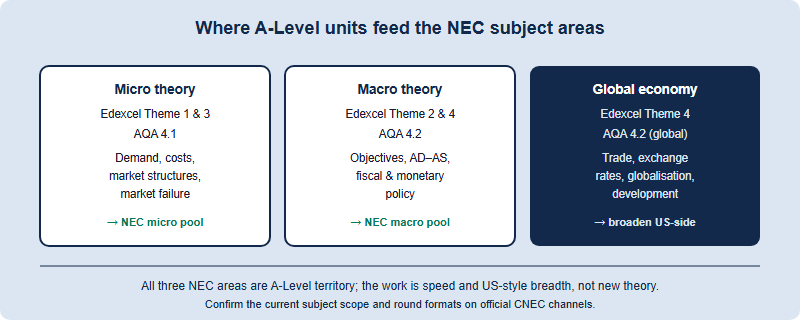
Mapping Edexcel and AQA units onto the NEC
The cleanest way to plan is to tag each A-Level unit against the NEC subject area it serves. Almost everything transfers. The table below is a planning guide, not a syllabus claim — always confirm the exact current NEC content scope on the official CNEC channels — but it shows how little net-new economics a UK student needs, and where the work actually sits.
| A-Level unit (Edexcel A / AQA 7136) | NEC subject area it feeds | What changes for the NEC |
|---|---|---|
| Edexcel Theme 1 / AQA 4.1.1–4.1.3 — markets, demand, supply, elasticity | Microeconomics | Direct theory; answer far faster than essay pace |
| Edexcel Theme 3 / AQA 4.1.5–4.1.7 — costs, revenues, market structures | Microeconomics | Direct; expect applied snap-judgement, less long evaluation |
| Market failure & government intervention (Theme 1/3, AQA 4.1.4) | Microeconomics | Direct; sharpen the US vocabulary (e.g. “deadweight loss”) |
| Edexcel Theme 2 / AQA 4.2.1–4.2.2 — objectives, AD–AS, multiplier | Macroeconomics | Direct; same models, instant recall over derivation |
| Fiscal & monetary policy (Theme 2, AQA 4.2.4) | Macroeconomics | Direct; watch UK-vs-US institutional framing |
| Edexcel Theme 4 / AQA 4.2.3 — international trade, exchange rates, globalisation | World / international economy | Mostly direct; A-Level already covers this well — broaden to current global events |
| Development economics (Theme 4 / AQA global) | World / international economy | Useful overlap; the NEC is more current-events-driven than the A-Level case studies |
Read the table and one thing stands out compared with other curricula: A-Level students get the world-economy row largely for free. Edexcel Theme 4 and the AQA global content already drill trade, exchange-rate systems, globalisation, and development — the very area AP students have to study from scratch. Your reading list is therefore shorter on content. The hours you save go almost entirely into the two things A-Level never measured: speed and US-style breadth.
The two skills A-Level under-drills
A-Level builds deep knowledge and written judgement. The NEC also tests how fast and how widely you can deploy that knowledge. Two specific habits separate a strong A-Level student from a competition-ready one.
- Speed and recall over evaluation. A-Level papers give you long minutes per response and reward the build of an argument — chains of analysis, evaluation, a judgement. NEC rounds such as the Qualifying Test, Super Econ, and the buzzer-paced Quiz Bowl reward instant retrieval and decisive single answers. Knowing monopoly “well enough for a 25-marker” is not the same as recalling the right fact in two seconds. Close this with timed multiple-choice drilling, not more essay practice. This is the single biggest adjustment for UK students.
- US-style breadth and framing. UK specs go deep on a defined set of models and tend to keep micro and macro in separate papers. The NEC ranges wider in a single sitting and uses US terminology and institutions — the Federal Reserve rather than the Bank of England, US data conventions, American textbook phrasing. The economics is the same; the labels and the breadth are not. Read across the whole syllabus in one pass rather than paper by paper, and learn the US vocabulary for concepts you already know.
There is a second, structural difference too. A-Level is sat as an individual. The NEC’s David Ricardo and Adam Smith divisions are teams of four, while the Pre division can be an individual or a small group of 2–4. A student used to working alone for two years has to learn to divide coverage and agree who answers what under buzzer pressure — a skill best practised early, not the week before. The division rules sit on the CNEC site; confirm them before you commit a team.
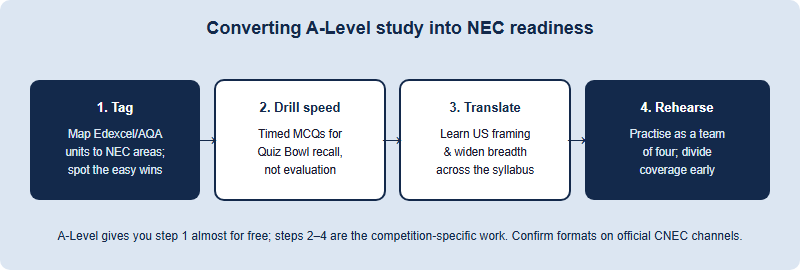
A unit-by-unit prep plan that reuses your spec
The advantage of A-Level is that your existing revision and your NEC prep can overlap heavily — you are not carrying two separate workloads, you are re-pointing one. Practically:
- Convert revision into timed recall. When you revise market structures (Theme 3 / AQA 4.1.5–4.1.7) or AD–AS (Theme 2 / AQA 4.2.2) for your exams, do a second pass under a strict timer in multiple-choice style. Same content you need for the summer, competition format on top.
- Lean on Theme 4 as a strength, then update it. Your international and development content is already strong — spend the extra time making it current. One weekly session on this year’s global macro stories turns A-Level theory into the live-events knowledge the NEC favours.
- Build a US-terminology bridge. Keep a running list as you revise: the US name and framing for each concept you know under a UK label. This is low-effort and pays off directly in the faster rounds.
- Choose your division by readiness, honestly. The Pre division (individual or 2–4) is a natural on-ramp for a student new to competition; David Ricardo and Adam Smith (teams of four) suit students with settled command and a settled team. The official division rules are on the CNEC site; confirm before you commit.
- Rehearse the seven-round shape. The NEC spans the Qualifying Test, Super Econ, Quiz Bowl, Critical Thinking, Econ Lab, Econ Immersion, and the U20 Youth Voice round. A-Level prepares the knowledge for the written rounds well; the applied and team rounds need their own rehearsal.
Note where the line of authority sits: the CEE sets the official academic standard and the NEC rules; the CNEC, run by Hanlin as the authorized China test center, runs the national round and is the only official route from China to the global rounds. Any named question-setters or judges associated with the contest are organiser claims — treat them as such and confirm officially rather than as settled fact.
What an A-Level grade does and does not tell you about NEC readiness
An A or A* at A-Level Economics is a genuine signal of deep conceptual command and strong written reasoning, and it puts you ahead on knowledge — arguably further ahead on theory than many US-curriculum entrants. What it does not predict, on its own, is a deep NEC run, because the Challenge measures two things A-Level does not: retrieval speed and breadth-under-pressure across the whole syllabus at once. The honest read is that a top A-Level grade is the floor, not the finish line: you start ahead on economics and even with everyone else on the competition-specific skills. Build the speed and the breadth on top, and rehearse as a team. We make no guarantee about results or admissions outcomes — this is a study plan, not a promise.
Frequently asked questions
Does A-Level Economics cover enough for the NEC?
Yes on theory — Edexcel Themes 1–4 and AQA 4.1–4.2 span all three NEC areas. The work is speed and US-style breadth. Confirm current scope on official CNEC channels.
Is the world-economy section a gap for A-Level students?
Less than for other curricula. Edexcel Theme 4 already drills trade and globalisation; just update it with current global events for the NEC.
Which NEC division should an A-Level student enter?
Pre (individual or 2–4) suits newcomers; David Ricardo and Adam Smith are teams of four for stronger students. Check division rules on the official CNEC site.
How do I enter the NEC from China?
Through the CNEC, the officially authorized China National Round run by Hanlin since 2016 — the only official path to the NEC global rounds. See the CNEC home page for current details.
Published by the NEC / CNEC editorial desk, operated by Hanlin Education as the officially authorized China National Economics Challenge (CNEC) test center. The NEC is run by the Council for Economic Education, which sets the official rules — always confirm current dates, divisions, fees and awards on the official CNEC channels. Corrections are made within 7 working days.