
Step up an NEC division when three things line up across a full season: your scores plateaued near the top of your current division, the syllabus has grown easier than your coursework, and you can field the team the next division requires. Moving up is a multi-year plan, not a single-spring decision — you climb when readiness is proven, not hoped for.
Why “moving up” is a different question from “which division now”
Deciding which National Economics Challenge (NEC) division to enter for the first time asks one question: where is this student today? Deciding whether to step up next season asks a harder one: has the student genuinely outgrown the division they just competed in? The two are easy to confuse, and confusing them is how strong competitors stall — either by repeating a division they have mastered, or by jumping a level before the evidence is there.
The NEC is run by the Council for Economic Education (CEE), founded in 1949, and reaches roughly 10,000 US students a year across microeconomics, macroeconomics and the world/international economy. In China, the official National Round is the CNEC, operated by Hanlin (SKT) since 2016 across 20+ provinces and 300+ schools — the only official path from China to the NEC global rounds. The three divisions — Pre (entry; an individual or a team of 2-4), David Ricardo (intermediate; a team of four) and Adam Smith (advanced; a team of four) — describe different starting points, so progressing through them is a sequence you can actually map over two or three years of school.
This guide is about that sequence: the readiness signals that tell you a step-up is earned, and how to plan a division path across seasons. It is not a single-season “choose your division” framework — for that first-time decision, see our companion piece on choosing your NEC division.
The four readiness signals that say you have outgrown a division
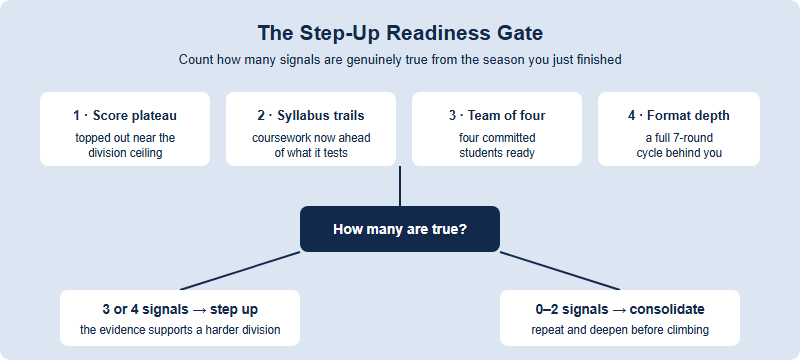
Treat a step-up as a decision you justify with evidence from the season you just finished, not a default that happens because a year passed. From a coaching standpoint, four signals matter most, and the honest test is whether you can point to several of them at once rather than just one.
- Score plateau near the ceiling. If your round results have settled at the top end of your current division and stopped improving, the division has stopped teaching you. A plateau low in the field means the opposite — stay and consolidate.
- Syllabus now trails your coursework. When the economics you study in class (an AP or IB course, for instance) has moved clearly ahead of what the division demands, the gap itself is the signal. The world/international economy carries more weight as you move up, so check that specifically.
- You can staff the next format. David Ricardo and Adam Smith require a committed team of four. A genuine step-up needs four students who will prepare together — not one strong individual hoping to carry three.
- Returning-competitor depth. Having already worked through a full cycle of the seven rounds — Qualifying Test, Super Econ, Quiz Bowl, Critical Thinking, Econ Lab, Econ Immersion and U20 Youth Voice — you know the rhythm and can spend next year on content, not on learning the format.
The figure below turns these into a simple gate: count the signals before you commit to a harder division.
Mapping a division path across two to three years
Because the divisions are starting points rather than difficulty tiers of one exam, the strongest students treat them as a runway. A student who joins NEC early has room to enter Pre, consolidate in David Ricardo, and aim for Adam Smith by their final years — but the path is a default to adapt, not a track everyone must follow. Plenty of students enter directly at David Ricardo or Adam Smith when their coursework and team already fit, and there is no rule that you must pass through Pre first.
The point of a multi-year map is to make each season’s choice deliberate: enter where the evidence puts you, then re-decide next year using the four signals above. The table contrasts the typical climb with two equally valid alternatives.
| Path | Year 1 | Year 2 | Year 3 | Best for |
|---|---|---|---|---|
| Classic climb | Pre (build the basics) | David Ricardo (team of 4) | Adam Smith (advanced) | Students who join NEC early, before formal econ |
| Mid-entry | David Ricardo | Adam Smith | Adam Smith (refine) | Students already mid-way through an econ course with a ready team |
| Direct-advanced | Adam Smith | Adam Smith (refine) | Global-round focus | AP/IB-Economics-level students & returning competitors |
Two cautions apply to every path. First, repeating a division you have clearly mastered wastes a season — if three signals are met, climb. Second, jumping before the team or the content is ready usually produces a weaker result in a harder division, which reads worse for admissions than a strong showing in the right one. Fit beats label in both directions. Exact divisions, eligibility and team rules can change year to year, so confirm the current season on the official CNEC pages before locking a plan.
How to time the step-up within one CNEC season
Once you have decided to move up, sequence the work so the harder division is a stretch you have prepared for, not a surprise. The seven rounds — Qualifying Test, Super Econ, Quiz Bowl, Critical Thinking, Econ Lab, Econ Immersion and U20 Youth Voice — reward teams that have rehearsed the format, so a returning competitor’s advantage is real. The timeline below sets out a sensible order of operations across a season.
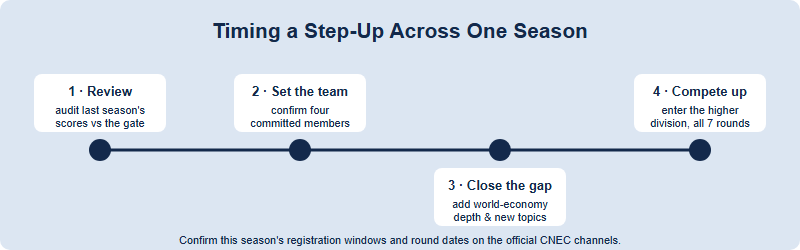
Notice what the timeline does not include: any specific dates. Registration windows, round dates and fees are set per season and can shift, so build your plan around the order of these stages and pin the calendar to whatever the official CNEC channels publish for the current cycle.
Common step-up mistakes (and the fix)
Most stalled progressions come from a handful of recurring errors. Naming them makes them easy to avoid.
- Climbing on one good result. A single strong round is not a plateau. Wait for a season-long pattern before committing to a harder division.
- Treating divisions as pure difficulty tiers. They are different starting points with shifting content weight (the world/international economy grows as you climb), so a step-up is a change of scope, not just harder questions.
- Solo step-up into a team division. One ambitious student cannot move from Pre into David Ricardo or Adam Smith alone — those divisions need four. Secure the team first.
- Chasing the label, not the fit. Entering Adam Smith for the name while underprepared usually backfires. A confident result in the right division signals more than a thin one in a harder track.
Used together, the readiness gate, the multi-year map and the in-season timeline turn “should we move up?” from a gut call into a decision you can defend with evidence — which is exactly the kind of disciplined thinking the NEC's seven rounds reward.
Frequently asked questions
How do I know I've outgrown the Pre division?
When your results plateaued near the top, your coursework now exceeds what Pre tests, and you can field a committed team of four for the next division.
Do I have to start at Pre and climb each year?
No. You can enter directly at David Ricardo or Adam Smith if your econ background and team fit. Confirm eligibility on the official CNEC pages.
Is moving up always better for admissions?
No. A confident result in the right division reads better than a weak result in a harder one. Fit beats label in both directions.
When in the season should I decide to step up?
Right after reviewing last season's scores, before registration — so you have time to set the team and close any content gap.
Published by the NEC / CNEC editorial desk, operated by Hanlin Education as the officially authorized China National Economics Challenge (CNEC) test center. The NEC is run by the Council for Economic Education, which sets the official rules — always confirm current dates, divisions, fees and awards on the official CNEC channels. Errors are corrected within 7 working days.