For many National Economics Challenge (NEC) participants, particularly those preparing for the AS Division or advanced DR tracks, interpreting economic news items presents a specific cognitive hurdle. It is not merely about knowing economic theory; it is about correctly identifying what a news snippet actually claims versus what a student assumes it implies. A frequent error involves conflating a raw data release with a policy explanation.
This article addresses that narrow but critical preparation problem. We will walk through two teaching illustrations to show where reasoning shortcuts fail, provide a diagnostic table to help you self-correct, and suggest a targeted practice sequence. This guidance complements broader curriculum mapping found in our overview of The Macroeconomics You Need for NEC: GDP, Inflation and Policy, Decoded, focusing specifically on the analytical mechanics of news interpretation.
The Core Difficulty: Data vs. Narrative
In NEC-style preparation, an economic news prompt often provides a short excerpt from a financial report, government announcement, or central bank statement. The task usually requires linking this excerpt to a theoretical model or evaluating its impact.
The trap lies in assuming causality where only correlation or reporting exists. A data release tells you what happened (e.g., inflation rose by 0.5%). A policy explanation tells you why it happened or what was done (e.g., the central bank raised rates to combat inflation). Students often import external knowledge or assumptions into the text, treating a neutral statistic as a directive action.
Teaching Illustration 1: The Inflation Report
Scenario: A news snippet states: “The Bureau of Labor Statistics reported that the Consumer Price Index (CPI) increased by 3.2% year-over-year in October, exceeding forecasts of 3.0%.”
Common Mistake: A student might argue, “This shows the Federal Reserve’s tight monetary policy is failing,” or “This proves supply chain issues are the primary driver.”
Analysis: The text contains only a data point. It does not mention the Federal Reserve, nor does it attribute the cause to supply chains. While these might be true in the real world, they are not supported by the provided text. The correct analytical step is to identify the deviation from expectations (3.2% vs 3.0%) and discuss its immediate implication for market sentiment or future policy expectations, without asserting the cause unless explicitly stated.
Teaching Illustration 2: The Central Bank Statement
Scenario: A different snippet reads: “The European Central Bank announced today that it will maintain interest rates at current levels, citing persistent core inflation risks despite recent easing in headline figures.”
Contrast: Here, we have a policy decision (maintaining rates) linked to a rationale (core inflation risks).
If a question asks for the likely effect on the Eurozone economy, you can validly use the rationale provided. However, if a subsequent question asks, “Why did the ECB decide to hold rates?”, the answer must strictly derive from the phrase “citing persistent core inflation risks.” Adding external factors like global growth slowdowns, even if economically plausible, introduces unsupported variables into the analysis.
Diagnostic Table: Identifying Reasoning Errors
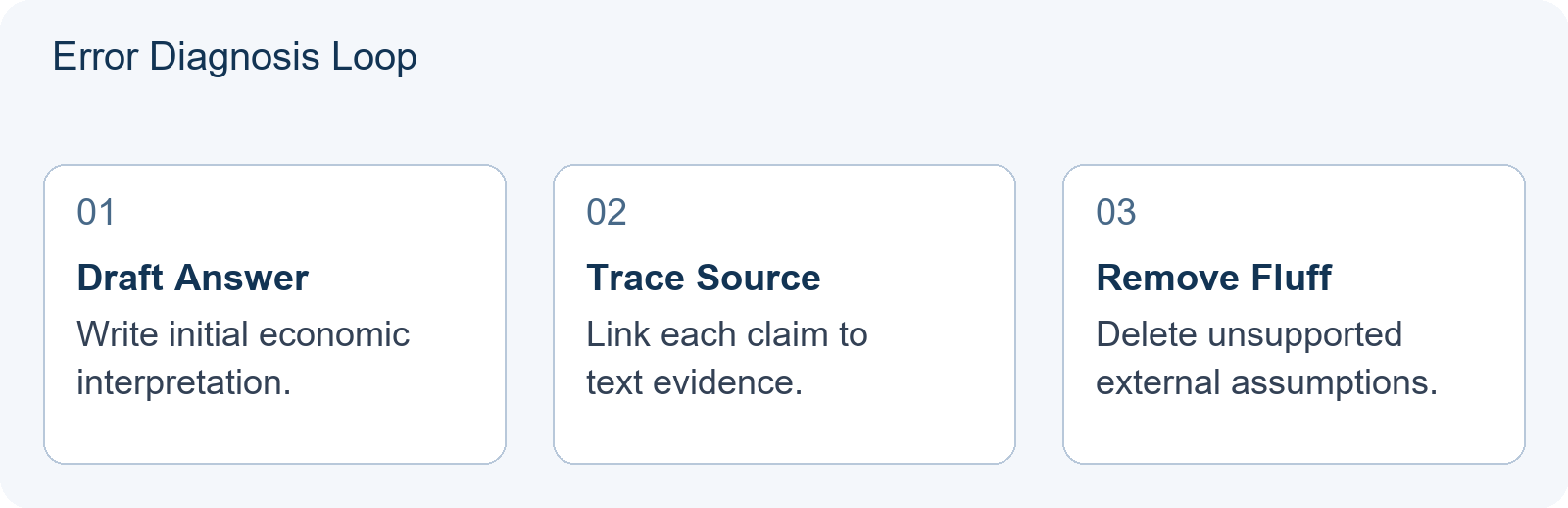
Use this table to audit your practice answers. If you find yourself in the “Unsupported Assumption” column, revise your response to stick closer to the text.
| Text Element | Valid Interpretation | Unsupported Assumption (Avoid) |
|---|---|---|
| “Unemployment fell to 4.1%” | Labor market tightened; potential wage pressure. | “Government job creation programs succeeded.” |
| “Oil prices dropped 10%” | Lower input costs for energy-intensive industries. | “Global demand collapsed due to recession.” |
| “Senate passed infrastructure bill” | Fiscal expansion expected in construction sector. | “Inflation will immediately spike by 2%.” |
| “Company X reported lower profits” | Reduced shareholder returns or cost-cutting measures. | “CEO made poor strategic decisions.” |
Targeted Practice Sequence
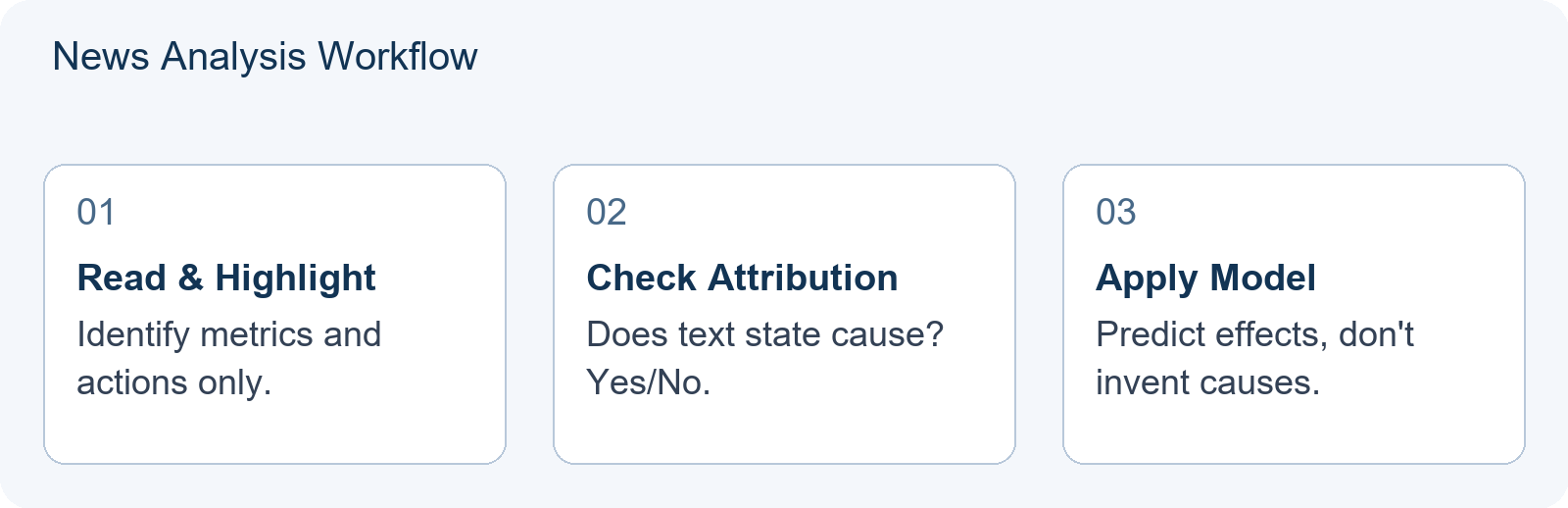
To build this skill, follow this three-step routine using past papers or mock scenarios.
- Highlight Verbs and Nouns: Circle every verb indicating an action (announced, cut, raised) and every noun indicating a metric (CPI, GDP, rate). Ignore adjectives initially.
- Separate Fact from Attribution: Draw a line between the event and any stated reason. If no reason is given, do not invent one. For example, in Teaching Illustration 1 above, there is no attribution of cause.
- Apply Theory Only After Validation: Once you have established what the text says, apply economic models (AD-AS, Phillips Curve) to predict consequences, not to explain origins unless the text supports it.
This method ensures your analysis remains grounded in the provided stimulus, which is crucial for scoring well in written analytical components. For context on how NEC structures its team rounds and advanced divisions, see NEC Global Round Singapore 2027: What the New Asia Stop Actually Adds to Your Calendar. For teams considering specialized tracks, review NEC Herbert Simon Division AI Track: Deciding Whether It Fits Your Team.
Course-Fit and Resource Preparation
If you find consistently struggling with separating data from narrative, consider whether your current study materials emphasize rote memorization of economic events rather than textual analysis skills. Effective preparation should include exercises that force you to justify every claim based solely on the provided excerpt.
When seeking additional support, look for resources that offer worked examples similar to the ones above, rather than just summary notes. Ensure any coaching or materials you use align with the specific demands of the NEC format, particularly the distinction between objective multiple-choice reasoning and subjective analytical writing.
Frequently Asked Questions
Can I use outside knowledge in NEC economic news analysis tasks?
You can use general economic theory to interpret consequences, but you cannot use outside facts to explain the causes of events described in the text unless the text explicitly mentions them. Stick to the stimulus for factual claims.
What if the news snippet is ambiguous?
If the text is ambiguous, acknowledge the ambiguity in your analysis. Discuss possible interpretations based on standard economic models, but clearly label them as possibilities rather than definitive conclusions drawn from the text.
How does this skill differ from Quiz Bowl preparation?
Quiz Bowl relies on rapid recall of facts and definitions. Economic news analysis requires slower, deliberate reading comprehension and logical deduction from a specific text passage, testing your ability to separate data from narrative.