
The National Economics Challenge (NEC) tests fiscal policy as a chain of cause and effect, not a slogan. You have to know that government has two levers — spending and taxes — that a change in either is amplified through the economy by the multiplier, that the multiplier shrinks as money leaks out to saving, taxes and imports, that government borrowing can crowd out private investment, and that automatic stabilizers work without anyone deciding anything. The marks live in those links.
The two levers: spending and taxes
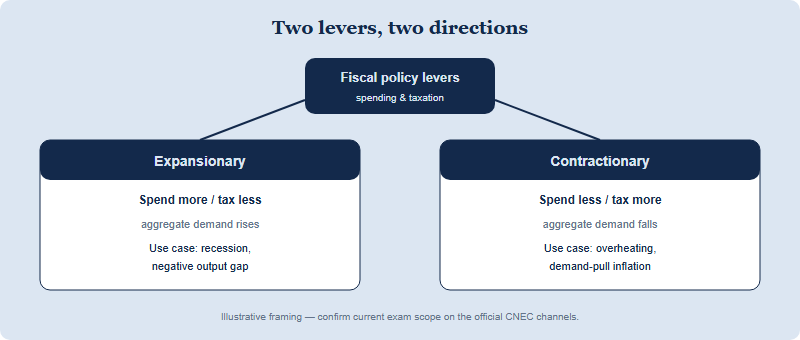
NEC items begin from a clean definition: fiscal policy is the use of government spending and taxation to influence aggregate demand and the level of economic activity. It splits into two directions. Expansionary fiscal policy — raising spending or cutting taxes — injects demand and is the textbook response to a recession or an output gap. Contractionary fiscal policy — cutting spending or raising taxes — withdraws demand and is aimed at an overheating economy with demand-pull inflation. The single most common discriminating item simply checks whether you can pair the direction of the lever with the state of the economy it suits.
The Council for Economic Education (CEE), founded in 1949, sets the academic standard the NEC is built on, and it treats fiscal policy as core macroeconomics alongside the micro and world-economy material; you can see where these topics sit in the official syllabus on the CNEC home page. Two precision points earn marks even before any arithmetic. First, a tax cut and a spending rise are not interchangeable: a dollar of direct government spending enters the spending stream in full, while a dollar of tax cut is partly saved by households, so spending changes carry a larger first-round punch than equal-sized tax changes. Second, the budget balance is a result, not a tool — a deficit happens when spending exceeds revenue, and expansionary policy tends to enlarge it; questions that ask you to read a deficit backwards into the policy stance are common.
- Expansionary — spend more or tax less; injects demand; suits a recession or negative output gap.
- Contractionary — spend less or tax more; withdraws demand; suits an overheating economy.
- Spending vs tax change — direct spending enters in full; a tax cut is partly saved, so its first-round effect is smaller per dollar.
| Concept | What it is | The trap NEC sets |
|---|---|---|
| Expansionary policy | Higher spending or lower taxes | Pairing it with an overheating economy |
| Contractionary policy | Lower spending or higher taxes | Prescribing it during a recession |
| Budget deficit | Spending exceeds revenue in a period | Treating the deficit as a policy lever, not a result |
| Tax cut vs spending rise | Different first-round impact per dollar | Assuming equal dollars give equal effects |
The multiplier: why one dollar moves more than a dollar
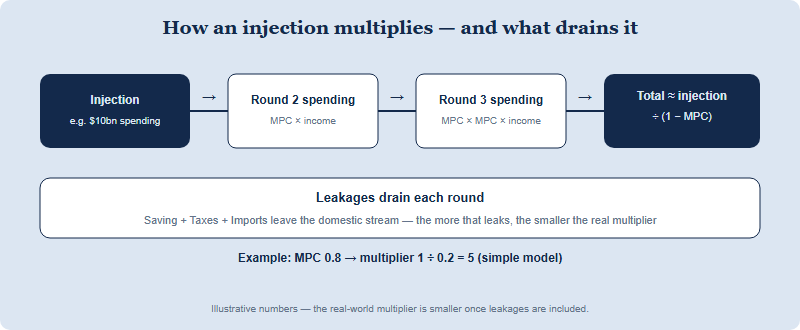
The most-tested fiscal skill is the multiplier — the idea that an initial injection of spending circulates and re-circulates, so the final change in output is a multiple of the first push. The logic is concrete: government pays a builder, the builder spends part of that income, the shop owner spends part of that, and so on. How much keeps circulating depends on the marginal propensity to consume (MPC), the fraction of each extra dollar of income that is spent rather than saved. The spending multiplier examiners reach for is 1 ÷ (1 − MPC): with an MPC of 0.8, the multiplier is 1 ÷ 0.2 = 5, so a $10 billion injection can lift output by up to $50 billion in the simple model. Drill that formula until it is automatic, because timed rounds give it to you bare.
The discriminating point is that the multiplier shrinks as money leaks out of the domestic spending stream. Saving is one leak (captured by the MPC), but so are taxes and imports — income paid to the tax authority or spent on foreign goods does not re-circulate at home. NEC rewards students who can say why a real-world multiplier is smaller than the textbook figure: the higher the marginal propensities to save, tax and import, the larger the leakages and the smaller the multiplier. This also explains the per-dollar gap from the previous section: because a tax cut is partly saved before it is ever spent, the tax multiplier is smaller in magnitude than the spending multiplier, a contrast that appears constantly in both calculation and reasoning items.
- Spending multiplier ≈ 1 ÷ (1 − MPC) in the simple model — the higher the MPC, the larger the multiplier.
- Leakages — saving, taxes and imports drain the circulating stream and shrink the real multiplier below the textbook value.
- Tax multiplier < spending multiplier — part of a tax cut is saved before it enters spending, so equal dollars do not give equal effects.
A first-party note from running the China round: the recurring multiplier error our CNEC teams make is not the formula — it is treating the textbook number as the real-world answer. Students compute 1 ÷ (1 − MPC), state a clean figure, and forget that tax and import leakages cut it down. We coach teams to name the leakages out loud in the analytical rounds, because "the multiplier is smaller once you account for taxes and imports" is exactly the sentence that separates a full-mark answer from a half one. For how this thread connects to the rest of the syllabus, see the CNEC editorial section.
Crowding out: the limit examiners love
Once the multiplier is solid, NEC items push on its limits, and the headline limit is crowding out. The argument: to fund expansionary fiscal policy, the government borrows; heavier borrowing raises the demand for loanable funds and pushes interest rates up; higher rates discourage private investment and interest-sensitive consumer spending. The result is that a slice of the demand the government adds is offset by private demand it displaces, so the net effect is smaller than the raw multiplier suggests. A strong answer states the mechanism — borrowing → higher interest rates → less private investment — rather than just naming the term.
The discriminating nuance is that crowding out is not all-or-nothing, and examiners reward students who say when it bites. In a deep recession with idle resources and slack credit, crowding out is weak, so fiscal expansion can be highly effective. Near full employment, with the economy competing for scarce funds, crowding out is strong, and the same expansion does more to raise interest rates than to raise output. This is also where the long-run debt caveat appears: sustained deficits raise the public debt and future interest burdens, a genuine cost to weigh against short-run stimulus. NEC does not ask you to take a political side; it asks you to lay out the trade-off cleanly.
- Mechanism — government borrowing raises interest rates, which reduces private investment and interest-sensitive spending.
- Depends on slack — weak when resources are idle (deep recession), strong near full employment.
- Long-run cost — persistent deficits add to public debt and future interest burdens, the counterweight to short-run gains.
| You are given… | Reason like this | Common mistake |
|---|---|---|
| A multiplier and an injection | Output change = injection × multiplier (simple model) | Ignoring leakages and crowding out |
| An economy near full employment | Expect strong crowding out, weaker output effect | Assuming the full multiplier always applies |
| A deep recession with idle capacity | Expect weak crowding out, strong stimulus effect | Claiming stimulus is always crowded out |
| A rising budget deficit from stimulus | Note the long-run debt and interest cost | Treating stimulus as cost-free |
Automatic stabilizers: the policy that runs itself
The last fiscal idea NEC reliably tests is the contrast between discretionary fiscal policy and automatic stabilizers. Discretionary policy is a deliberate decision — a new spending package, a tax-rate change — and it suffers from lags: a recognition lag before the problem is seen, a decision lag while it is debated, and an implementation lag before the money moves. Automatic stabilizers, by contrast, kick in without any new decision. A progressive tax system takes a smaller bite as incomes fall in a downturn, leaving households more to spend; unemployment benefits and welfare transfers rise automatically as more people qualify. Both cushion the fall in demand on their own, and both fade as the economy recovers.
Examiners prize the precise reason stabilizers matter: they act immediately and counter-cyclically, dampening the swings of the business cycle exactly because no one has to vote first. The classic discriminating item asks you to label which fiscal effects are automatic and which require a decision — a stimulus bill is discretionary; the rise in benefit payments during a recession is automatic. A common trap is calling a one-off relief package an "automatic stabilizer": if it had to be legislated, it is discretionary. Keeping that line clean is worth a mark on its own.
For a China team preparing through CNEC — the official China National Round, operated by Hanlin (SKT) since 2016 across 20+ provinces and 300+ schools, and the only official path from China into the NEC global rounds — the practical takeaway is to rehearse these as ready distinctions, because they recur in every register of the competition. Confirm the current round structure and weightings on the official CNEC channels before you build a prep plan, since formats can change between seasons.
How fiscal items show up across the NEC rounds
Fiscal policy is not confined to one part of the competition; it surfaces across the seven rounds — Qualifying Test, Super Econ, Quiz Bowl, Critical Thinking, Econ Lab, Econ Immersion and U20 Youth Voice — and the skill the round prizes changes the kind of fiscal question it sets. In the timed multiple-choice and buzzer rounds, expect crisp definition-and-calculation items: compute a spending multiplier from an MPC, pick the correct policy direction for an output gap, or identify an automatic stabilizer. In the analytical and applied rounds, expect a scenario you must diagnose and argue — whether a proposed package will work given the economy's slack, and what trade-offs (crowding out, debt) any answer must weigh.
- Calculation register — the spending multiplier from MPC, output change from an injection, pairing direction to the cycle. Train to reflex.
- Analytical register — diagnose whether stimulus suits the situation, explain crowding out, weigh deficits against demand support.
- Vocabulary precision — expansionary vs contractionary, spending vs tax multiplier, discretionary vs automatic. Examiners build distractors from these pairs.
FAQ
What is the spending multiplier in NEC questions?
In the simple model it is 1 ÷ (1 − MPC): an injection raises output by a multiple of itself, larger when the marginal propensity to consume is higher.
Why is the tax multiplier smaller than the spending multiplier?
Part of a tax cut is saved before it is ever spent, so it enters the spending stream weaker than a dollar of direct government spending, which enters in full.
What is crowding out?
Government borrowing to fund stimulus can raise interest rates, which reduces private investment and offsets part of the demand the spending adds, shrinking the net effect.
How do automatic stabilizers differ from discretionary policy?
Stabilizers like progressive taxes and unemployment benefits act on their own as the economy moves; discretionary policy needs a new decision and suffers from lags.
Published by the NEC / CNEC editorial desk, operated by Hanlin Education as the officially authorized China National Economics Challenge (CNEC) test center. The NEC is run by the Council for Economic Education, which sets the official rules — always confirm current dates, divisions, fees and awards on the official CNEC channels. Any factual error will be corrected within 7 working days.