Students aiming to deepen their expertise in international economics and enhance their study abroad profiles should not miss the NEC Economics Competition! This guide comprehensively covers the 2026 NEC registration portal, step-by-step process, detailed competition rules, division selection, and addresses the most frequently asked questions regarding team formation and preparation planning.
Why Choose the NEC Competition?
Authoritative Organizer, Globally Recognized Academic Gold Standard
When choosing a competition, its background is paramount. The NEC is officially organized by the Council for Economic Education (CEE), an institution with nearly 75 years of history. The CEE is the developer of the U.S. K-12 financial literacy standards and the creator of the AP Economics curriculum framework.
Dual Purpose: Highly Compatible with School Curricula
For students enrolled in international curricula, the NEC offers a highly efficient advantage. Its knowledge framework overlaps by 80%-85% with the economics modules of mainstream international programs like AP, IB, and A-Level.
Preparing for the NEC inherently serves as an in-depth review and reinforcement of school coursework. Official data shows that after systematic preparation, students' in-class economics grades improve by an average of over 40%, and the AP Economics score-5 rate increases by 42%.
- AP Students: Bridges the gap of AP exams' heavy theory and light practice focus, enhancing case analysis skills.
- IB Students: The academic paper writing in the Case Study Analysis section provides excellent rehearsal and practical experience for the Extended Essay (EE).
- A-Level Students: Through higher-difficulty quantitative analysis training, the accuracy rate on data analysis questions improves by an average of 39% after preparation.
Multidimensional Training: Building the Soft Skills Matrix for Future Leaders
Unlike standard exams, the NEC evaluates students' comprehensive abilities through its multi-stage format (Economics Assessment, Case Study Analysis, Economic Innovation Challenge, and Econ Super Bowl), covering critical thinking and problem-solving, teamwork and leadership, and public speaking and adaptability.
NEC Competition Registration Process
Registration Period: June to November 2026 (No late registrations accepted)
Registration Portal: Bloom Education Platform
Registration is exclusively supported through the official NEC website: https://www.webloom.cn/bloom_web/
- Register an Account: Visit the official NEC website, click Register, and fill in personal details such as name, email, and password to complete account creation.
- Select a Division: The NEC is divided into Pre, DR, and AS divisions. Choose the appropriate division based on your academic level and grade.
- Form a Team: The NEC is a team-based competition. Each team consists of 2-4 students and can be formed across different schools and grades.
- Fill in Registration Details: After logging in, navigate to the registration page and enter team members' basic information, school details, and advisor information. Ensure all data is accurate to avoid delays in the competition process. Before the November 30 deadline, the team captain must lock in the competition division (Pre/DR/AS) via the task card. Pre-formed teams can freely mix members across schools. The team's school defaults to the captain's school, which is a key detail on the award certificate and can only be modified once.
- Pay the Registration Fee: Pay the fee of 698 RMB per person (Regional Station fee) on the registration page and keep a complete electronic payment receipt. Additionally, select a preliminary station assessment time slot for your team before December. If not selected, the system will automatically assign one.
- Confirm Successful Registration: Upon successful payment, you will receive a confirmation email. Please save this email and related receipts for future reference and verification.
Detailed NEC Competition Rules
Eligible Participants
The NEC is open to students in grades 7-12 worldwide.
Competition Timeline
Registration Period: June 6 - November 30, 2026
Preliminary Station: December 2026
China National Station: March 2027
Global Finals: June/August 2027
(Based on last year's timeline; subject to official announcements)
Team Formation Requirements
Pre Division (Introductory): 2-4 students per team. Suitable for grades 7-9 students with zero foundation or only introductory exposure to IGCSE Economics.
DR Division (Intermediate): 4 students per team. Suitable for grades 10-11 students who have already studied Microeconomics or Macroeconomics (AP/IB/A-Level).
AS Division (Advanced): 4 students per team. Suitable for grades 11-12 students who have systematically studied both Microeconomics and Macroeconomics. The advancement rate to the Global Finals is 15%.
Competition Structure
The NEC consists of three stages: Preliminary Station, China National Station, and Global Finals:
- Preliminary Station: Online Economics Assessment (120 minutes), testing Microeconomics, Macroeconomics, and current international economic events.
- China National Station: Offline multi-stage evaluation, including Economics Assessment, Case Study Analysis (Classic/Smart modes), and Economic Innovation Challenge.
- Global Finals: Hosted across three venues (USA, Asia/Hong Kong, UK). Features more international formats such as the Econ Super Bowl and U20 Youth Voice.
Competition Rounds
Case Study Analysis
- Classic Mode: Submit an academic paper + PPT defense. This is the only pathway to advance to the Global Finals.
- Smart Mode: Submit only a PPT presentation. Ideal for teams with shorter preparation time.
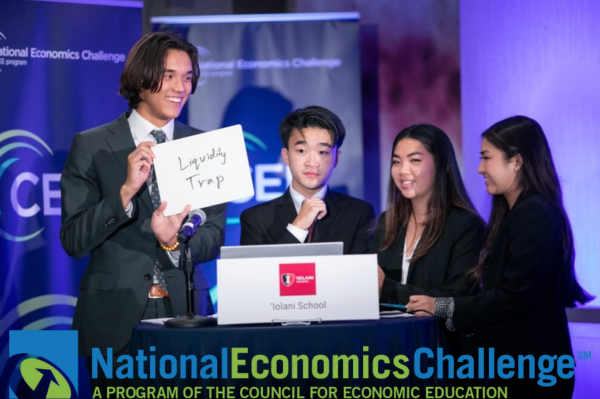
Econ Super Bowl
A live buzzer round covering macro/microeconomic knowledge and indicator interpretation, testing instant reaction and risk-decision-making skills.
U20 Youth Voice
Focuses on global economic hot topics (e.g., climate change, AI governance). Teams produce policy recommendations or research reports, aiming for recognition from academia and industry.
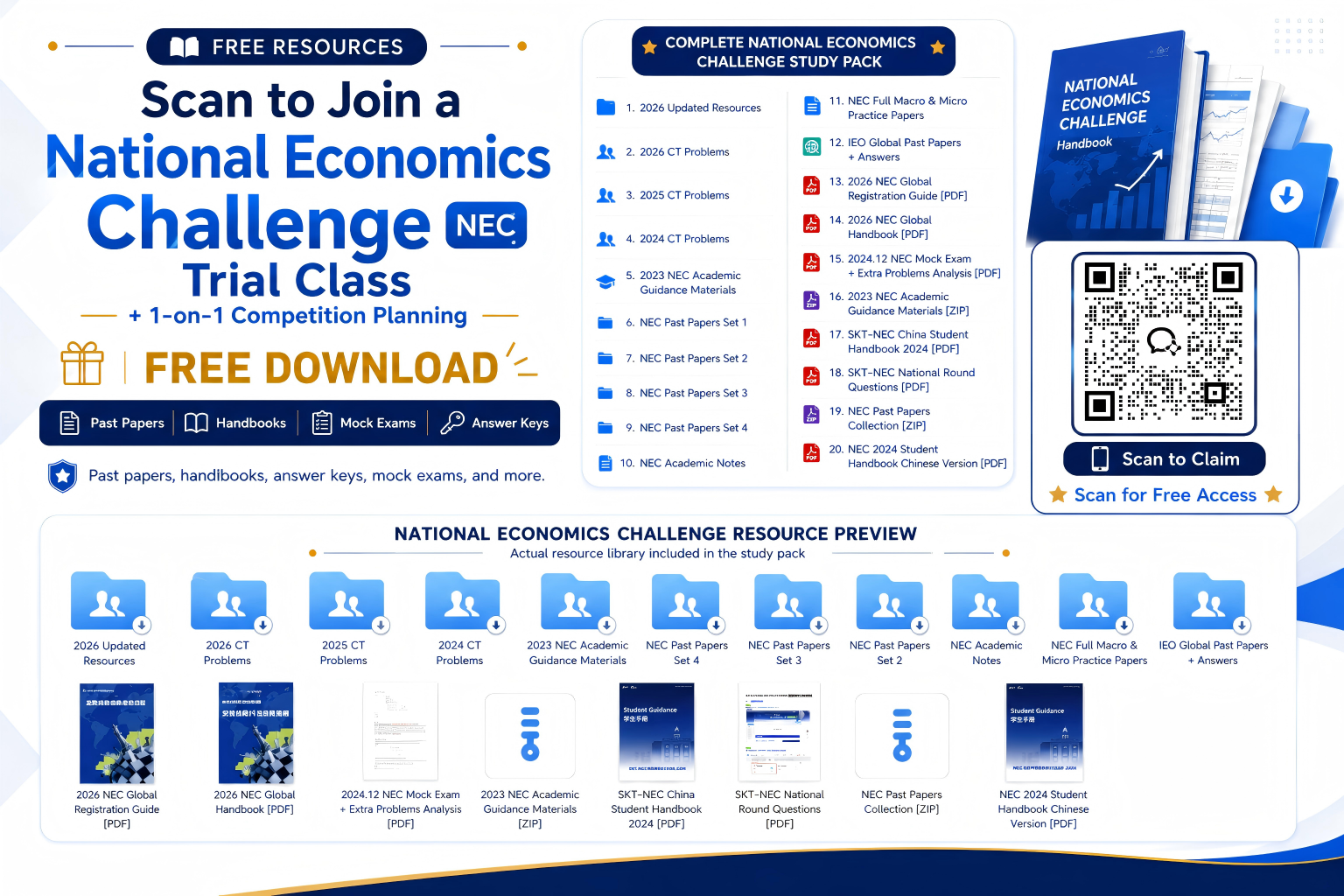
Get FREE NEC Preparation Materials
Scan the QR code below to access free practice papers, study guides, and past competition materials. Start preparing today!