Is the NEC Economics Competition Worth It? A Complete Guide for International Students

In the competitive landscape of international education, business and economics competitions are a core choice for enhancing academic profiles. The National Economics Challenge (NEC), as a benchmark event in the field of economics, consistently ranks on the must-participate list for international student families.

Is the NEC truly valuable? Does it significantly boost applications to top UK and US universities? Today, we will comprehensively break down why the NEC is considered the gold standard for international students' business and economics background enhancement, covering its prestige, competition content, schedule, and more.

Introduction to the NEC Competition

The NEC is a global high school economics competition hosted by the Council for Economic Education (CEE). Founded in 2000, it boasts a 26-year history and spans over 30 countries, with more than 20,000 students participating annually. It is one of the largest and most academically recognized high school economics competitions in the world.

What is the Relationship Between NEC and CNEC?

Many parents wonder why the competition in China is called CNEC. In 2017, the NEC officially entered mainland China. To align with the Chinese educational system and local student profiles while maintaining international academic standards, the official regional event was named CNEC. Its core model is International Standards + Local Adaptation.

International Origin: The question design, judging criteria, and competition format are identical to the global event. Certificates are globally recognized, with no difference in recognition by top US and UK universities.

Local Optimization: Case studies incorporate Chinese economic hot topics (such as the digital economy, dual circulation, and new energy industries), aligning with the knowledge systems of students in AP, IB, A-Level, and domestic international curricula.

In short, CNEC is the official Chinese regional branch of the NEC. The name difference is purely for localization. Its prestige and authority are fully synchronized with the global competition. Chinese students can advance to the Global Finals through CNEC to compete with top students worldwide.

NEC Assessment Content & Divisions

The NEC uses a team-based format (cross-school teams are allowed). It is divided into 3 divisions based on students' economics foundation, covering all levels from beginner to advanced. Before registering, students must select their division and form a team:

  • Pre Division (Beginner): Grades 7-9. For students with zero foundation or only introductory IGCSE economics. Tests 36 multiple-choice questions (24 microeconomics + 12 macroeconomics). Focuses on real-life scenarios. Maximum advancement is to the China Finals.
  • DR Division (Intermediate): Grades 9-11. For students who have completed AP/IB/A-Level microeconomics or macroeconomics. Tests 48 multiple-choice questions (16 each in micro, macro, and international economics & current affairs). Includes case analysis, with current affairs accounting for 30%.
  • AS Division (Advanced): Grades 11-12. For students who have systematically completed both micro and macroeconomics, aiming for Ivy League/G5 universities. Tests 48 advanced multiple-choice questions. Case analysis difficulty is highest, adding topics like behavioral economics and dynamic IS-LM curve analysis. Only the AS Division can advance to the Global Finals.

Core Competition Rounds (China Finals / Global Finals)

  1. Economics Test (Objective Questions): Individual closed-book written exam covering microeconomics (supply & demand, market structures), macroeconomics (GDP, monetary policy), and international economics & current affairs (international trade, exchange rates). Solidifies theoretical foundations.
  2. Case Study Analysis (Team): A 4-person team analyzes a real-world economic case (the 2026 China Finals theme is Smart Economy, focusing on AI's impact on industries). Teams must write an English report and participate in an on-site defense, testing logical thinking and teamwork.
  3. Economic Innovation Challenge / Super Bowl: Timed team buzzer rounds and debate. Tests quick adaptability and flexible application of knowledge.

Competition Progression & Timeline

The NEC progression follows: Preliminary Individual Round → China Finals → Global Finals. Specific dates typically follow the annual academic calendar, with registration opening in late fall, regional rounds in winter, and the global finals in spring.

Is the NEC Competition Highly Valued?

1. Top Academic Recognition: Elite Question Design & Judging Panel

The NEC question design team consists of senior CEE economists, Ivy League economics professors, and Wall Street financial experts. The judging standards align with undergraduate economics programs. Questions combine academic depth with real-world relevance, making it the only high school economics competition officially recognized by the U.S. Department of Education.

2. Green Channel for Top UK & US Universities: Significantly Higher Admission Rates

The NEC is a core business/economics competition officially recognized by top universities like Harvard, MIT, Oxford, Cambridge, and LSE. Popular majors such as Oxford's PPE and LSE's Economics explicitly list NEC awards as significant bonus factors.

  • Official data shows: Over 60% of NEC Global Finalists are admitted to Ivy League or G5 universities, with 20% securing offers from these elite institutions.
  • Preparation aligns highly with AP/IB/A-Level curricula: Covers over 85% of international economics course content. Participants see an average score increase of 39.2% in microeconomics and 46.6% in macroeconomics. The competition and school learning mutually reinforce each other.

3. Comprehensive Skill Development: From Knowledge to Mindset

  • Academic Ability: Systematically master micro and macroeconomic theories, building a solid economics thinking framework.
  • Soft Skills: Develop teamwork, academic writing in English, public speaking, and quick adaptability.
  • Global Perspective: Focus on global economic hot topics, understand the logic behind economic phenomena, and seamlessly transition to undergraduate business studies.


Get FREE NEC Preparation Materials

Scan the QR code below to access free practice papers, study guides, and past competition materials. Start preparing today!

推荐

A Beginner’s Guide to the NEC Economics Competition: Full Overview, Award-Winning Strategies, and Long-Term Preparation Advice

The NEC National Economics Challenge is one of the most influential economics competitions for secondary school students worldwide. It is beginner-friendly, accessible even to students with no prior economics background, and highly valuable for applications to Economics, Business, Finance, and related majors in the UK, the US, Hong Kong, and other destinations.

A Full Overview of the NEC Competition

The NEC is open to students in Grades 7 to 12 worldwide, and participation must be in teams.

The competition usually progresses through three stages: the regional preliminary round, which is held online, followed by the China finals, which are held offline, and then the global round, which includes the United States, Asia, and the United Kingdom.

The admissions value of the NEC is one of the main reasons for its popularity. According to the source text, more than 60 percent of students who reached the global round were eventually admitted to top universities, and more than 20 percent received offers from elite institutions such as Harvard, Yale, and Oxford.

推荐

NEC Competition Timeline

Based on the 2025 season for reference, the expected timeline is as follows:

Registration deadline: 30 November 2026
Preliminary round: mid to late December 2026
China finals: late February to early March 2027
Global round in New York: May to June 2027
Global round in Hong Kong or the United Kingdom: July to August 2027

NEC Divisions

Pre Division

This division is designed for students in Grades 7 to 9 who are complete beginners or have only had limited exposure to introductory economics. Teams may have 2 to 4 members. Students in this division may advance to the China round, but they are not eligible for the global round.

David Ricardo Division

This division is intended for students in Grades 10 to 11 who have already studied one economics course, such as AP, IB, or A-Level Economics, and therefore have some prior foundation. Teams must have 4 members. Students choosing the Classic format may qualify for the global round.

Adam Smith Division

This division is designed for students in Grades 11 to 12 who have already completed a full and systematic study of both Microeconomics and Macroeconomics. Students in this division should have a strong academic foundation. Teams must have 4 members. This division is eligible for the global round and usually offers a higher proportion of advancement places.

NEC Competition Components

Qualifying Test

This is an objective test that covers Microeconomics, Macroeconomics, and International Economics. It goes beyond basic definition-based questions and increasingly incorporates multiple data sources and more complex real-world scenarios. Students are expected to integrate knowledge and use economic reasoning at a higher level.

Critical Thinking

This is a team-based component in which students work on a provided economics case. The process includes gathering information, analyzing it, writing a report, and applying relevant economic theories to produce clear conclusions. Teams then present their work to judges and respond to questions. This component develops research ability, writing skills, public speaking, and on-the-spot response skills, while also strengthening critical thinking habits.

Super Econ!

This is a fast-paced and engaging team challenge based on timed responses. It is designed to test students’ alertness, their grasp of basic economics knowledge, and the team’s level of coordination. It is especially useful for training quick economic thinking and teamwork.

Quiz Bowl

In this component, teams compete head-to-head in a live buzzer format. It tests concentration, judgment, and reaction speed. If a team buzzes in too early and answers incorrectly, it gives the other team an opportunity to take advantage. This makes it one of the clearest expressions of strategic competition within the NEC.

How to Win Awards in the NEC

Build a Team Strategically

Teamwork plays a decisive role in higher-level awards.

Clear division of responsibilities inside the team is essential. One student may focus on objective-question theory, another may take the lead in case analysis and writing, while another may be strongest in fast-response rounds.

Regular full-team mock practice is also important. Teams should rehearse Critical Thinking and Quiz Bowl style tasks in order to build rhythm, improve communication, and strengthen live coordination.

Prepare in Stages

A well-structured preparation plan is the key to stable progress.

Foundation Stage

Work through the core knowledge points of economics systematically, build a clear knowledge framework, and understand the most important concepts and models.

Practice Stage

Focus on objective-question training, improve solving speed and accuracy, and strengthen the scoring foundation.

Advanced Improvement Stage

Train specifically for case analysis, team discussion, and fast-response competition. Become familiar with standard answering structures and competition-style logic.

Final Sprint Stage

Complete full mock papers, review mistakes carefully, memorize major current economic topics, and adjust mental state before the competition.

Practical Exam Strategies

In the preliminary round, objective questions should be handled from easy to difficult. Do not spend too much time on one hard question. The priority is to avoid losing marks on basic questions.

In case analysis, students should answer using a clear structure such as background, problem, economic model, and policy recommendation. A logical and organized presentation is more likely to earn a high score.

In fast-response rounds such as Super Econ! or Quiz Bowl, students should be cautious. If they are unsure, they should avoid rushing to answer blindly.

Additional Ways to Improve Award Potential

Students can strengthen their NEC preparation by aligning it with IGCSE, AP, or A-Level Economics content. This allows competition preparation to reinforce school academics at the same time.

It is also helpful to read accessible economics books and follow financial and economic news regularly. This builds economic intuition and prepares students for flexible case-based questions.

For students starting from zero, the NEC is not only manageable, but also an excellent entry point into economics competitions. With the right division, a strong team, and a phased preparation plan, it is entirely possible to move from beginner level to award level.

推荐

A Top Competition Choice for International Business Applicants: The NEC Golden Preparation Period Has Arrived

A strong academic credential for business and economics applicants is here. The preparation window for the new NEC season has officially opened. As an economics and business competition highly recognized by Ivy League and G5 universities, the NEC aligns well with AP, IB, and A-Level curricula and covers three major core components: the Economics Challenge Test, Critical Thinking, and the Innovation Challenge. Whether you are a beginner in business competitions or a student with prior economics knowledge, this guide brings together the NEC timeline, competition structure, scoring rules, team formation, and training focus to help you prepare efficiently for the global round.

NEC Competition Timeline

Based on previous years, the expected NEC schedule is as follows:

NEC registration period: June to September 2026
NEC preliminary round: December 2026
NEC China finals: February 2027
NEC global rounds:
United States study round: May to June 2027
Asia study round: July to August 2027
United Kingdom study round: July to August 2027

推荐

NEC Competition Structure

1. NEC Regional Round: Preliminary Stage

At the regional stage, the competition includes only the Economics Challenge Test.

Format: individual written test, 60 minutes

Question volume by division:

Pre Division for Grades 7 to 9: 40 questions in total, including 20 Microeconomics questions and 20 Macroeconomics questions

David Ricardo and Adam Smith divisions for Grades 10 to 12: 45 questions in total, including 15 Microeconomics questions, 15 Macroeconomics questions, and 15 International Current Events questions

Scoring:

Each correct answer earns 10 points. Incorrect or unanswered questions receive 0 points. For team results, only the top two or top three members’ scores are counted, depending on the division.

Advancement:

The top 20 percent of teams in each region advance directly to the China finals. The remaining places are filled by the top 20 percent in national ranking.

CNEC 2026 Preliminary Round Advancement Score Boundaries

Pre Division: about 650 teams participated, about 390 teams advanced, cutoff score 450

David Ricardo Division: about 900 teams participated, about 740 teams advanced, cutoff score 810

Adam Smith Division: about 400 teams participated, about 240 teams advanced, cutoff score 880

2. NEC China Finals

The China finals consist of four major core components.

Economics Challenge Test

Pre Division: 36 questions in total, including 24 Microeconomics questions and 12 Macroeconomics questions, full score 360

David Ricardo and Adam Smith divisions: 48 questions in total, including 24 Microeconomics questions, 12 Macroeconomics questions, and 12 Current Events questions, full score 480

Critical Thinking

This is the core round of the finals.

Students work in teams of four and complete a case analysis within 48 hours. In the global round, the time limit is 40 hours.

There are two main formats:

Classic: essay, PowerPoint, and collaboration report

Smart: PowerPoint and report only, which is the mainstream format in the China finals

Teams then give a live presentation and answer judges’ questions. This round carries significant weight, and on-the-spot response ability is extremely important.

Super Econ!

This is a team-based timed challenge with 15 multiple-choice questions. Team members may discuss the questions. It tests both basic economics knowledge and collaboration ability.

New Featured Components Added in 2026

Two special practical components were added in 2026:

City Partner limited component

Young Economist Scholars Defense

China Finals Advancement and Award Ratios

Based on 2025 data, the top 15 percent of teams nationwide received team Gold, Silver, or Bronze awards, with a total of 77 teams. The top 5 percent received individual Gold, Silver, or Bronze awards, and the top 5 percent also received various individual honors.

3. NEC Global Round

The NEC global round includes the United States round, the Asia round, and the United Kingdom round.

Featured components include activities such as Quiz Bowl and youth economics communication events.

Why NEC Is Worth Preparing For

The NEC is attractive because it does much more than test textbook economics. It combines academic knowledge, real-world case analysis, teamwork, presentation, and timed response challenges. This makes it especially suitable for students applying to business, economics, finance, and public policy programs.

Its strong overlap with AP, IB, and A-Level also makes it a highly efficient competition to prepare for. Students can strengthen school economics knowledge while building a more competitive academic profile for university applications.

For international students aiming at top universities, the NEC is not only a competition but also a platform to demonstrate economic thinking, teamwork, communication ability, and applied analysis.

How to Use the Golden Preparation Window

If you plan to compete in the new season, the current period is ideal for preparation.

Students should first identify the most suitable division based on grade level and economics background. Then they should build a team early and divide responsibilities clearly. During the first stage of preparation, it is best to strengthen Microeconomics and Macroeconomics fundamentals. After that, teams should move into past paper training, timed mock tests, current-events accumulation, and case analysis practice.

For teams aiming at the China finals or global round, presentation ability and live defense practice should also become part of regular training.

推荐

Why Is NEC a Must-Do Competition for Business Students? The Golden Preparation Window for the 2026 Season Has Opened

The NEC is often the first competition business-minded students think about.

Why? Three words: high, broad, and reliable.

It offers high academic value, a broad knowledge system, and a strong track record for top university applications.

In this article, we will use competition details and performance-related facts from your source text to explain why the NEC is worth serious attention for international students in Grades 9 to 12 in the new 2026 season.

What Is the NEC?

The NEC, or National Economics Challenge, is organized by the Council for Economic Education, usually known as the CEE. It has a history of more than 20 years, covers more than 50 countries, and attracts over 100,000 students each year.

The CEE is one of the most authoritative institutions in K-12 economics education in the United States. It has played an important role in the development of economics curriculum standards across all 50 states. The NEC is the CEE’s flagship economics competition for high school students around the world and is often described as the “Olympics of Economics.”

Since entering China in 2016, the NEC has grown rapidly. Participation in the China division has exceeded 10,000 students, with more than 800 schools involved.

推荐

Why Is NEC So Important for Business and Economics Applicants?

1. A Strong Academic Credential for Top Universities

According to the information in your source text, more than 60 percent of NEC global finalists have gone on to receive offers from top universities such as Harvard, Yale, Oxford, Cambridge, and Stanford. More than 20 percent of U.S. national finalists have entered Ivy League universities.

The structure of the NEC naturally identifies students with strong critical thinking, teamwork, data analysis, and public speaking ability. These are exactly the qualities that admissions officers at top universities value most.

2. Strong Alignment with International Curricula

Preparing for the NEC is also an effective way to reinforce school economics courses.

More importantly, NEC is not the kind of competition where students memorize content for an exam and forget it afterward. In the Critical Thinking component, students must apply economic theory to real-world issues. That is exactly the kind of depth that traditional school examinations such as AP, IB, and A-Level often cannot fully provide.

In that sense, the NEC can be seen as a stronger, broader, and more application-oriented extension of school economics courses.

The overlap with common international curricula can be summarized as follows:

Curriculum Approximate Knowledge Overlap with NEC
AP Microeconomics About 90%
AP Macroeconomics About 80%
IB / A-Level Economics Highly aligned

3. A Competition Format That Tests Full-Spectrum Ability

The NEC does not rely only on written tests. It includes five core components.

Economics Challenge Test

This is a standardized objective test covering Microeconomics, Macroeconomics, and International Economics and Current Events.

Critical Thinking

Teams complete an in-depth economic case analysis, from gathering data to writing a report and then presenting and defending their conclusions before judges. The process closely simulates a real business consulting environment.

Super Econ!

This is a timed challenge that tests quick thinking and team coordination under pressure.

Quiz Bowl

Qualified teams face each other in live buzzer-style competition, creating an intense and highly competitive final-round atmosphere.

Econ Lab

This component asks students to use economics together with fields such as psychology and sociology to solve real-world economic problems.

This multi-layered design is one of the key reasons NEC is so attractive to students aiming for business, finance, economics, and public policy.

What Is New in the 2026 NEC Season?

According to the source text, the 2026 season introduces several notable updates.

For the first time, the NEC global round will include a UK host site. In addition to the existing U.S. site in Atlanta and the Asia site in Hong Kong, a new UK site in Oxford will be added.

The China division will also introduce two new practical components.

The first is a “City Partner” limited component, in which students work as “city consultants” and propose solutions to real economic problems in partnership with local governments and businesses.

The second is the “Young Economist Scholars Defense,” which is open only to high-quality academic paper teams in Classic mode and features a more rigorous defense-style presentation format.

These additions further strengthen NEC’s practical and interdisciplinary character.

NEC Competition Timeline

Based on the timeline provided in your source text, the 2026 season is expected to follow this schedule:

Registration period: 16 July 2026 to November
China preliminary round: December 2026
China finals: March 2027

Global rounds:
U.S. round: 28 May to 1 June 2027
Asia round: early August 2027, location to be announced

This timeline is based on the 2025–2026 schedule pattern and remains subject to official confirmation.

NEC Divisions

The NEC offers three divisions designed for different levels of economics background.

Pre Division

Teams of 2 to 4 students. This division is suitable for Grades 7 to 9 students with no prior background or only limited exposure to IGCSE Economics.

David Ricardo Division

Teams of 4 students. This division is suitable for Grades 10 to 11 students who have already studied either Microeconomics or Macroeconomics through AP, IB, or A-Level.

Adam Smith Division

Teams of 4 students. This division is suitable for Grades 11 to 12 students who have studied both Microeconomics and Macroeconomics systematically. According to the source text, the global-round advancement rate in this division reaches 15 percent.

Choosing the correct division is critical. The best choice is not always the highest one, but the one that matches a student’s actual academic foundation and preparation level.

How Should Students Prepare for NEC?

Seven months is described in your source text as the golden preparation window for NEC.

A practical preparation plan can be divided into three stages.

Time Period Main Tasks
June to August, summer break Systematically study the foundations of Microeconomics and Macroeconomics, choose the division, and build the team
September to November, autumn term Complete registration and payment, take at least two full mock tests, and practice past papers
December, final sprint Review weak areas, adjust performance state, and participate in the online preliminary round

This preparation rhythm is especially suitable for AP students. Since NEC overlaps strongly with AP Microeconomics and AP Macroeconomics, students who build a solid NEC foundation during the summer often find their school economics courses much easier once the new term begins.

Final Thoughts

For students planning to apply for business, economics, finance, public policy, or related majors, the NEC is far more than just another competition. It combines theory, application, teamwork, presentation, and real-world thinking in a way that very few high school competitions can match.

That is why NEC is often considered a must-do competition for business-minded students. If you are targeting the 2026 season, the key is not to wait until the last minute. The most effective time to start is now, while the preparation window is still wide open.

推荐

Is the NEC National Economics Challenge Worth Taking for Economics and Business Applicants? A Practical Guide for the 2026–2027 Season

Recently, I spoke with several high school students who are preparing to apply for business, economics, and related majors. One feeling came up again and again: relying only on AP, IB, or A-Level Economics grades no longer seems enough to stand out in a highly competitive application pool. If students want to show admissions officers that they have genuine academic interest in the field, participating in high-value academic competitions has become increasingly important.

Among the competitions mentioned most often is the NEC, the National Economics Challenge.

Now that it is 2026, we are at the transition point between two competition seasons. This is a good moment to take an objective look at what the NEC actually tests, how difficult it is, and how students should plan if they want to compete in the new season.

推荐

Where Are We in the NEC Timeline Right Now?

Students reading this article now should first understand one key point.

The 2025–2026 NEC preliminary round was already held in December 2025. At the beginning of 2026, students who advanced are preparing for the China finals in April 2026, while the global finals will be held in May 2026.

So if you are only now learning about the NEC and planning to join, the season you are really preparing for is the 2026–2027 season.

Based on the usual NEC schedule from previous years, the new season is likely to follow this timeline, although the final dates will depend on official announcements:

Registration opens: expected in June 2026
Registration deadline: expected in late November 2026
China preliminary round: expected in December 2026, held online
China finals: expected in March or April 2027
Global finals: expected in May 2027

The NEC is a team competition. Students must compete in teams of two to four and cannot participate individually. From a planning perspective, this is actually a very good time to begin.

What Is the NEC and Why Is It So Popular?

NEC stands for the National Economics Challenge. It is organized by the Council for Economic Education in the United States.

There are two main reasons why it is so highly valued.

First, the NEC does not only test multiple-choice knowledge. It also includes case analysis and economic debate, which means it can reflect a student’s ability to apply economic theory to real-world issues rather than simply memorize textbook content.

Second, based on data from previous years, more than 60 percent of students who achieved strong NEC results eventually received offers from highly regarded universities, including Ivy League schools and top business programs. This does not mean those offers were caused by the competition alone, but it does show that the NEC can serve as a solid and persuasive academic credential.

Three Divisions: Choosing the Right One Is Critical

The NEC is divided into three categories based on students’ academic background. Choosing the wrong division can hurt both performance and confidence.

Pre Division

This division is generally recommended for students in Grades 8 and 9. It is suitable for students who have not yet studied economics systematically or who are only beginning to explore the subject.

David Ricardo Division

This division is generally recommended for students in Grades 10 and 11. It is suitable for students who have already studied either Microeconomics or Macroeconomics.

Adam Smith Division

This division is generally recommended for students in Grades 11 and 12. There is an important condition here: students should already have completed both Microeconomics and Macroeconomics before competing. This is the most difficult division and requires deeper theoretical understanding and stronger analytical ability.

A conservative approach is usually the best when choosing a division. Matching the competition level to your actual academic foundation matters far more than picking the most advanced division for appearances.

Division Overview

Division Introduction Requirement Subjects Team
Pre Division The content of the Pre Division is closely related to real-life scenarios. This division is designed to generate students’ interest in economics and prepare them for higher-level economics courses in middle school. Before August 2022, students must have never taken any economics course, or have only taken IGCSE Economics. Microeconomics, Macroeconomics Team of 2–4
David Ricardo Division The DR Division tests students’ understanding of economic terms and theories. It aims to strengthen students’ foundation in economics and prepare them for related undergraduate study. Before August 2022, students must have studied either Microeconomics or Macroeconomics. Microeconomics, Macroeconomics, International Economics and Current Events Team of 2–4
Adam Smith Division The AS Division tests both students’ understanding of economic theory and their ability to apply it. It focuses on theoretical understanding and practical use in real life. This division aims to improve students’ research ability in economics and prepare them for further study in the field. No specific prerequisite listed. Microeconomics, Macroeconomics, International Economics and Current Events Team of 4

How NEC Scoring Works

The individual scoring system is straightforward.

In the Pre Division, there are 36 questions in total, including 24 Microeconomics questions and 12 Macroeconomics questions. Each question is worth 10 points, so the full score is 360.

In the David Ricardo and Adam Smith divisions, there are 48 questions in total, including 24 Microeconomics questions, 12 Macroeconomics questions, and 12 International Economics and Current Events questions. Each question is worth 10 points, so the full score is 480.

The team scoring system is more strategic.

For the Pre Division, the team score is not the sum of all team members’ scores. Instead, only the top two scoring students in the team are counted, and their best subject scores are combined. The full team score is 720.

For the David Ricardo and Adam Smith divisions, only the top three scoring students in the team are counted, and their best subject scores are combined. The full team score is 1440.

This rule has an important implication. A team does not need four all-around students who are equally strong in every topic. A more effective strategy may be to divide responsibilities. One student can focus on Microeconomics, another on Macroeconomics, and another on current events. If each student can maximize performance in one area, the team’s overall score can rise significantly. This is why choosing the right teammates and assigning preparation tasks wisely matters so much.

What Makes the NEC Difficult?

Although the scoring rules allow for strategy, the overall advancement rate in the NEC is not especially high. Official data show that the average award rate in the preliminary round is around 40 percent, while only about 20 percent of participants advance to the China finals.

So where does the real difficulty lie?

For students in the David Ricardo and Adam Smith divisions, the challenge goes beyond Microeconomics and Macroeconomics. There are also 12 questions on international economics and current events. These do not come with fixed textbook answers and rely heavily on long-term background knowledge and regular exposure to economic news.

In the later stages of the competition, students must also handle case discussion and economic debate. This means memorization is not enough. Students must gradually develop real economic intuition and the ability to reason through unfamiliar issues.

In recent NEC seasons, students who performed strongly in the preliminary round and advanced to the China finals generally shared one important strength: they had a precise grasp of key tested concepts and completed substantial targeted training in weak areas such as current events and case-based expression.

Advice for Students Preparing in 2026

If you are currently in Grade 10 or Grade 11, are studying economics, and hope to apply in the future to business, finance, economics, or public policy, the NEC is a competition well worth your time.

Since the preliminary round of the 2026–2027 season is expected at the end of the year, you still have more than half a year to prepare. There is no need to rush into difficult practice questions immediately. A better approach is to first build a solid foundation in Microeconomics and Macroeconomics while also following financial and economic news on a regular basis.

If you are not yet sure about your current level, do not know which division fits you best, or are still looking for suitable teammates, it makes sense to evaluate your situation carefully before deciding how much time and energy to invest.

推荐

Complete Guide to the NEC National Economics Challenge: Preparation Strategies for AP, IB, and A-Level Students

The NEC National Economics Challenge is officially certified by the Council for Economic Education. It is one of the most globally recognized economics competitions for high school students.

The competition is highly aligned with AP, IB, and A-Level Economics curricula. Preparing for NEC can also help students strengthen their school coursework, making it a valuable academic profile-building opportunity for students applying to economics, business, finance, and related majors.

推荐

NEC Competition Timeline and Division Settings

NEC Competition Timeline

The following timeline is based on the 2025 season for reference.

Registration deadline: November 30, 2026

Preliminary Round: Mid to late December 2026

China Round: Late February to early March 2027

Global Round, New York: May to June 2027

Global Round, Hong Kong / United Kingdom: July to August 2027

NEC Division Settings

Pre Division: Suitable for students in grades 7–9, especially those with IGCSE Economics experience or no prior economics background. This division focuses on basic microeconomics and macroeconomics concepts. The highest advancement level is the China Round.

David Ricardo Division: Suitable for students in grades 9–11 who have studied one economics course, such as AP Microeconomics. This division covers microeconomics, macroeconomics, and international economics. Around the top 10% of students may advance to the Global Round.

Adam Smith Division: Suitable for students in grades 10–12 who have systematically completed both microeconomics and macroeconomics. This division tests complex models and quantitative analysis. It is considered the most academically rigorous division, with around the top 15% advancing to the Global Round.

NEC Competition Content

Regional Round

Economics Assessment: This is an individual written test consisting of objective questions. Students must answer within a limited time. It tests theoretical understanding, problem-solving speed, and accuracy.

China Round

Economics Assessment: This section further tests students’ ability to apply economics knowledge, with increased difficulty compared with the Regional Round.

Critical Thinking Case Analysis: Teams research real-world economic cases, submit a report, and complete a defense session. This section evaluates logical analysis, research depth, English communication, and teamwork.

Super Econ: This is a timed team-based question-answering challenge. It tests reaction speed, strategy, and team coordination.

Quiz Bowl: This is a buzzer-style head-to-head round. It evaluates breadth of knowledge, on-the-spot response, and the ability to perform under pressure.

Global Round

The Global Round focuses on case analysis, in-depth discussion of international current affairs, and Quiz Bowl. It places strong emphasis on cross-cultural perspective, academic depth, and insight into the global economy.

NEC Award Preparation Strategies for Different Curricula

AP Students

Advantages: AP students have a strong overlap with NEC content, usually around 80% to 95%. Graph analysis, such as supply and demand curves, is often a major strength.

Areas to improve: AP Economics focuses more on theory, so students need to supplement their knowledge of international economics and current affairs, such as Federal Reserve policy and global supply chains. They should also improve English academic writing skills.

Action plan: Use AP past papers to build a strong foundation. Read The Economist every week to accumulate materials for case analysis.

A-Level Students

Advantages: A-Level students often have strong mathematical skills and are good at handling complex calculation questions, such as elasticity and cost-benefit analysis. Their economics knowledge coverage is also relatively comprehensive.

Areas to improve: A-Level courses involve fewer case analysis tasks, so students need to strengthen the depth and clarity of their logical reasoning. Since NEC follows a more American-style economics framework, students should also become familiar with terminology related to the U.S. economic system.

Action plan: Use mind maps to organize key knowledge points. Focus on interdisciplinary topics such as game theory and geoeconomics.

IB Students

Advantages: IB students usually have strong essay-writing skills, which are highly suitable for NEC’s Critical Thinking Case Analysis section. Topics such as development economics and globalization are also key parts of IB Higher Level Economics.

Areas to improve: IB Economics places less emphasis on calculation, so students need to strengthen quantitative analysis skills, such as basic modeling with Stata or R. They should also follow emerging topics such as carbon finance and the digital economy.

Action plan: Practice more NEC calculation questions. When forming a team, consider working with teammates who are strong in mathematics to create a more balanced team.

推荐

The New Season of the NEC Economics Challenge Has Begun: Your Economics Allies Are Ready to Climb the Academic Peak with You

The National Economics Challenge, also known as NEC, is more than just an exam. It is a condensed version of a real-world economics battlefield. In this competition, students face complex data, conflicting decisions, and constantly changing global case studies.

For students interested in economics, NEC is an excellent opportunity to demonstrate both academic strength and practical application skills.

Why Is NEC a Must-Choose Competition for Business Applicants?

A Strong Indicator for Top University Applications

The National Economics Challenge is hosted by the Council for Economic Education, also known as CEE. It is one of the most influential high school economics competitions in the world.

CEE is the organization behind the U.S. K-12 financial literacy standards and has also contributed to the development of the AP Economics curriculum framework. This gives NEC strong academic authority and credibility.

Statistics show that more than 60% of NEC Global Round participants are eventually admitted to world-leading universities such as Harvard, Oxford, and Cambridge. For students planning to study abroad, an NEC award can become one of the most convincing academic credentials in their application profile.

推荐

Highly Complementary to School Economics Courses

The NEC knowledge system overlaps by more than 85% with mainstream international economics curricula such as AP, IB, and A-Level. Preparing systematically for NEC is also a process of deepening and expanding school-based economics knowledge.

For AP students, the foundation in microeconomics and macroeconomics is usually strong. The content overlap with the NEC Preliminary Round is above 80%. However, students need to strengthen case analysis skills, shift their thinking from exam-oriented problem solving to real-world application, and supplement their knowledge of international current affairs.

For A-Level students, the curriculum covers a broad range of topics and provides a natural advantage in essay writing. This background is especially helpful for NEC’s Critical Thinking Case Analysis section. However, students should focus on targeted practice for the Economics Assessment.

For IB students, the emphasis on critical thinking is highly aligned with NEC. However, students need to understand and memorize key definitions, improve public speaking skills, and strengthen their ability to respond under pressure.

CNEC Economics Literacy Workshop

The CNEC, or China National Economics Challenge, Economics Literacy Workshop attracts more than 20,000 young economics learners every year. Students from dozens of countries and regions participate in the event.

The CNEC knowledge system is highly compatible with major international curricula, including AP, IB, and A-Level Economics.

Who Is Suitable for NEC?

NEC is open to students in grades 7–12 who are under the age of 20.

2026–2027 Season Timeline

The following timeline is based on the 2025–2026 season for reference.

NEC competition pathway: Preliminary Round, China Round, and Global Round in the United States, Asia, or the United Kingdom.

Registration period: September to November

NEC Preliminary Round: Mid to late December

NEC China Round workshop stage: March of the following year

NEC Global Round, U.S. Station: May to June of the following year

NEC Global Round, Asia Station: July to August of the following year

NEC Global Round, U.K. Station: July to August of the following year

NEC Divisions

All NEC participants compete in teams. Students advance from the Preliminary Round to the China Round, and then to the Global Round.

NEC Pre Division: 2–4 students per team. This division is mainly designed for students in grades 7–9.

NEC DR Division: 4 students per team. This division is generally suitable for students in grades 9–11.

NEC AS Division: 4 students per team. This division is designed for students in grades 10–12.

Team formation note: The Pre Division allows teams of 2–4 students, while DR and AS teams must consist of 4 students. NEC encourages cross-grade collaboration, as students from different grade levels can complement one another with different strengths and knowledge backgrounds.

NEC New Season Team Recruitment Has Begun

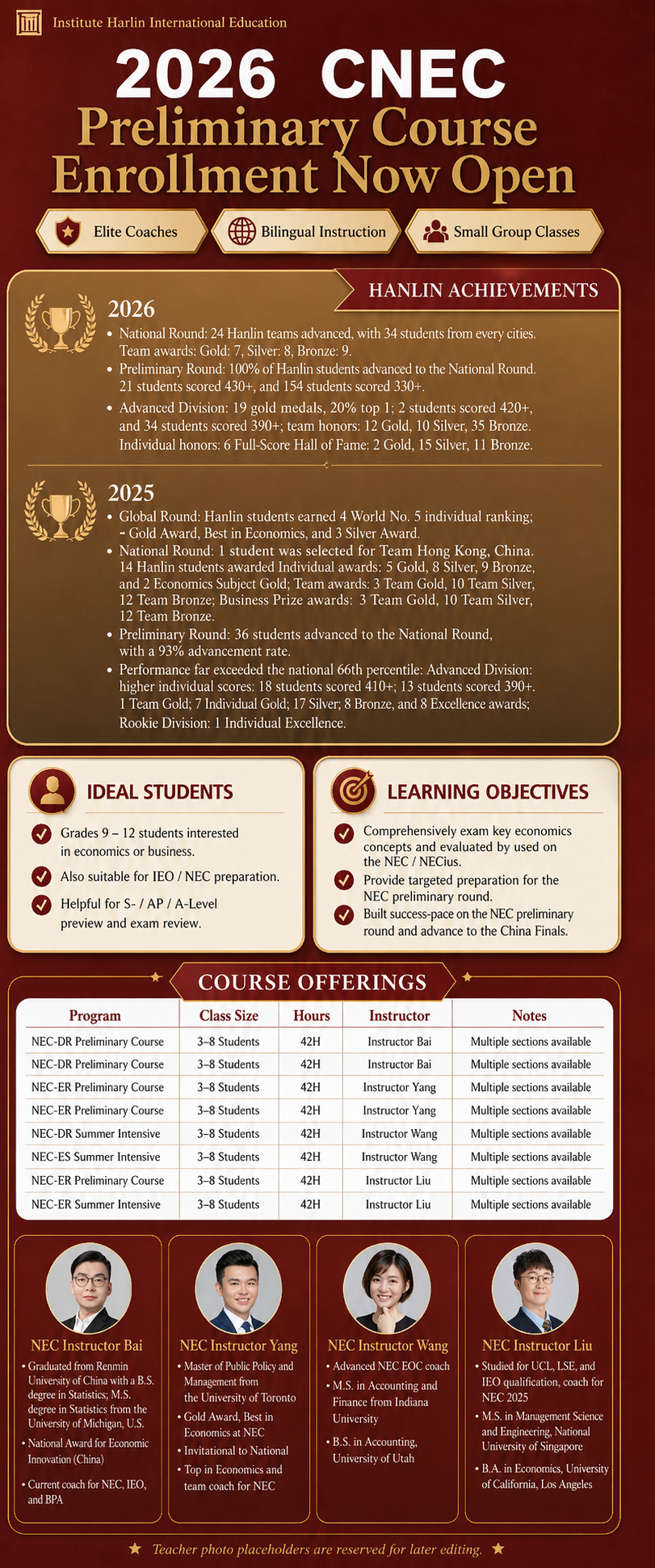
Hanlin’s NEC team formation program is now open.

Our team matching process has two steps. First, students go through Hanlin’s initial screening. Then, potential teammates confirm with one another. Students who want to form their own team are also welcome to contact our consultants, and we can assist with the team creation process.

For several consecutive years, Hanlin has helped students find NEC teammates. Our students come from leading international high schools around the world, including schools in Shanghai, Beijing, Guangzhou, Shenzhen, U.S. high schools, and U.K. high schools. With a strong pool of team formation resources, students have more options when looking for suitable teammates.

NEC DR Division Team Opening: One Student Looking for Three Teammates

Student K

School: U.S. high school

Grade: Grade 10

Academic performance: GPA 4.00

SSAT: 2400

TOEFL: 111 out of 120

Relevant courses: AP Microeconomics, AP Macroeconomics, physics, Spanish, darkroom photography, visual arts

Competition experience: Wharton Global High School Investment Competition, Diamond Challenge, Blue Ocean Competition

Activities:

Founded a youth-led nonprofit organization to help underprivileged children in Hong Kong gain access to sports facilities. Each program provides basketball coaching for more than 30 children and has raised over USD 2,000 in seed funding.

Member of Green Guard, debate club, academy program, Latin club, Model United Nations, and economics club.

Regularly writes feature articles for the school’s monthly print publication, focusing on student well-being, campus topics, and global current affairs.

NEC DR Division Team Opening: One Student Looking for Three Teammates

Student C

School: Nantong International School

Grade: Grade 9

Curriculum: A-Level

Economics background: Currently studying A-Level microeconomics in Grade 9. Economics grades over two semesters are equivalent to around GPA 3.7. The student has also self-studied microeconomics and macroeconomics outside school.

Activities and competitions:

Captain of a 2025 NEC Pre Division team

Participant in 2025–2026 AMC 10

School activities:

Starting player on the volleyball team

Organizer of school clubs

Scholarship recipient currently preparing a research presentation project

This student has a strong passion for economics and hopes to work with teammates toward the Global Round.

NEC DR Division Team Opening: One Student Looking for Three Teammates

Student K

School: World Foreign Language School

Grade: Grade 10

School economics background: Scored 6 in Pre-IB Economics and is currently studying the first year of IBDP Economics. The student is expected to complete the first-year IBDP Economics curriculum before September.

Language score: TOEFL 110 out of 120

Activities:

Participated in the school economics club and math club

Received an offer for a summer program at Boston University in July, a two-week economics and computer science study program

Hanlin NEC and IEO Global Round Preparation Courses

Hanlin has extensive experience in NEC and IEO economics competitions. Over the years, Hanlin has helped many students achieve outstanding results in these competitions.

Hanlin CNEC and IEO Exclusive Study Materials

To help students prepare with clear structure and reliable resources, two of Hanlin’s gold-medal economics coaches have jointly developed exclusive CNEC and IEO study materials.

These materials are designed strictly according to the exam syllabus. They integrate systematic learning, lecture notes, and practice questions into one complete preparation system, helping students improve step by step and aim for higher awards.

Hanlin’s latest CNEC and IEO study materials cover all required knowledge points and organize them into clear modules with both text and graphics.

Hanlin’s economics instructors have also developed a new NEC practice question set. It includes key exam topics and covers the major knowledge points from IB, AP, and A-Level Economics, helping students prepare more efficiently.

推荐

Hanlin NEC New Season Preliminary Round Courses Are Now Open for Enrollment

All students who register for the CNEC Global Round program through Hanlin can receive the latest CNEC study materials for free.

推荐

Hanlin Economics and Business Competition Instructor Team

Economics Instructor: Mr. Bai

Master’s degree in Social Entrepreneurship from Hult International Business School, San Francisco campus

Selected teaching results:

NEC 2026

Coached 8 teams at the NEC National Round. Among them, 6 teams advanced to the Global Round, 1 team won a Team Gold Award, 2 teams won Team Silver Awards, 3 teams won Team Bronze Awards, 1 team won a Regional Gold Award, and 2 teams won Best Critical Writing Team awards.

Coached 26 students at the NEC Regional Round, with all students advancing to the National Final.

NEC 2025

At the NEC Global Round Americas Station, coached one AS Division team that ranked second overall with a team score of 1150. Also coached one DR Division team that ranked fourth overall.

At the Global Round Hong Kong Station, coached a team that ranked seventh in the Critical Thinking section and won a Team Bronze Award.

At the NEC National Round, coached 8 teams, with 4 teams advancing to the Global Round and 1 AS team placed on the waitlist. Three students entered the Hall of Fame with perfect scores. One team won a Team Gold Award, one team won a Team Silver Award, and two teams won Team Bronze Awards.

At the NEC Regional Round, coached 34 AS students, all of whom advanced to the National Final.

NEC 2024

At the 2024 NEC National Round, coached 11 teams, including 6 DR teams and 5 AS teams. Among them, 7 teams advanced to the Global Final, including 3 DR teams and 4 AS teams, and 1 DR team was placed on the waitlist.

DR Division teams ranked second and third nationally.

Three students entered the Hall of Fame with perfect scores in AS International Economics and Current Affairs, DR Macroeconomics, and DR Microeconomics.

Three DR teams won Team Gold Awards, two AS teams won Team Silver Awards, one team won a Team Bronze Award, and two teams were recognized as Top Teams in the Critical Thinking section.

At the 2024 NEC Regional Round, 9 out of 10 coached teams advanced to the National Final, including 3 AS teams and 6 DR teams.

IEO 2026

At the IEO National Final, coached 2 students who were selected for the Chinese national team, which consisted of 10 students in total. Two students advanced to the IEO Singapore Station. One team won a Team Gold Award, one team won a Team Bronze Award, two teams won Silver Awards in the Business Presentation section, and five students won individual Bronze Awards.

At the IEO Preliminary Round, coached 15 students, 10 of whom advanced to the National Final. Students won 3 Gold Awards, 1 Silver Award, and 3 Bronze Awards at the preliminary stage.

IEO 2025

At the IEO Global Final, coached Li from Shenzhen Middle School, who ranked fifth globally, won an individual Global Gold Award, and received the Best in Economics title. Also coached Li from Hong Kong ISF Academy, who won a Global Bronze Award.

At the IEO National Final, coached 22 students, 14 of whom advanced to the Global Round. Three students won individual Gold Awards and entered the national team interview stage. One student was selected for the first Chinese national team, and one student was selected for the second Chinese national team. Five students won individual Silver Awards, and six students won individual Bronze Awards.

One team won a Team Gold Award, two teams won Team Silver Awards, and two teams won Team Bronze Awards. One team won a Gold Award in the Business Presentation section and advanced to the second round of the Business Presentation. One team won a Silver Award in the Business Presentation section, and two teams won Bronze Awards in the Business Presentation section.

At the Preliminary Round, coached 15 students, all of whom advanced to the National Final. Students won 6 Gold Awards, 3 Bronze Awards, and 3 Silver Awards at the preliminary stage.

IEO 2024

One student won a Silver Award at the IEO Global Round, ranked among the top three representatives from the Hong Kong regional team, and ranked 27th globally.

At the National Final, one team won a Team Bronze Award, and two students won Silver Awards in the individual written assessment section.

At the IEO Preliminary Round, two teams advanced to the National Final.

Hanlin Economics and Business Competition Instructor: Ms. Yang

Full-scholarship master’s degree in Economics from the University of British Columbia

Selected teaching results:

NEC

2025–2026 National Round

Among the 12 teams coached at the National Round, 7 successfully advanced to the Global Final, and 3 teams were placed on the Global Round waitlist.

Two teams won National Round Overall Team Gold Awards, five teams won Overall Team Silver Awards, and two teams won Overall Team Bronze Awards.

Two students entered the Hall of Fame with perfect scores.

Two teams won QT Team Gold Awards, and one team won a CT Team Gold Award.

Eighteen students received QT Individual Distinction honors.

2025–2026 Regional Round

All 9 coached teams, including 2 AS teams and 7 DR teams, successfully advanced to the National Round.

Four teams won Team Gold Awards, three teams won Team Silver Awards, and one team won a Team Bronze Award.

Among the students, two entered the Microeconomics Hall of Fame, one entered the Macroeconomics Hall of Fame, five won National Individual Overall Gold Awards, eight won National Individual Overall Silver Awards, and two won National Individual Overall Bronze Awards.

2024–2025 Global Round

At the Global Round U.S. Station, the coached AS Division team ranked first globally in overall team score.

At the Global Round U.S. Station, the coached AS Division team ranked first globally in team QT score.

At the Global Round U.S. Station, the coached AS Division team ranked first globally in Macroeconomics Team QT, second globally in Microeconomics Team QT, and second globally in International Economics Team QT.

Among the coached AS Division students at the Global Round U.S. Station, students ranked first, third, and fifth globally in individual QT total score.

At the Global Round U.S. Station, the coached AS Division team ranked third among Chinese teams in the Quiz Bowl section.

At the Global Round Hong Kong Station, the coached AS Division team won a Global Team Silver Award and ranked in the Global Top 10 for Macroeconomics, International Economics and Current Affairs, and Critical Thinking.

2024–2025 National Round

All 4 coached AS Division teams successfully advanced to the Global Final.

Three AS teams won National Round Team Overall Silver Awards, and one AS team won a National Round Overall Bronze Award.

One DR team won a National Round Overall Silver Award, and one DR team won a National Round Overall Bronze Award.

One team won Best CT Team Writing.

One student won an individual QT Gold Award, one student won an individual QT Silver Award, and one student won a QT Bronze Award.

2024–2025 NEC Regional Round

All 8 coached teams, including 3 AS teams and 5 DR teams, successfully advanced to the National Round.

Three AS teams won Team Silver Awards, and four DR teams won Team Bronze Awards.

Two students entered the International Economics Hall of Fame, one student won an individual Gold Award, two students won individual Silver Awards, and five students won individual Bronze Awards.

2023–2024 NEC National Round

One coached DR Division team successfully advanced to the Global Final.

2023–2024 NEC Regional Round

All 5 coached teams, including 1 AS team and 4 DR teams, successfully advanced to the National Round.

IEO

2025–2026 National Round

One student was selected for the national team.

2025–2026 Preliminary Round

Four students successfully advanced to the National Round, and all four won individual Silver Awards.

2024–2025 Global Round

One member of the Chinese national team coached by Ms. Yang won an individual Gold Award and ranked fifth globally. The Chinese national team ranked third globally.

2024–2025 National and Regional Rounds

At the National Round, one coached team won a National Team Overall Bronze Award. One student won an individual Overall Silver Award, and one student won an individual Overall Bronze Award.

At the Hong Kong regional selection, one coached student successfully entered the Hong Kong representative team, and one student won a Gold Award.

2024–2025 IEO Regional Round

Seven coached students successfully advanced to the National Round. Among them, one student won an individual Gold Award, and four students won Bronze Awards.

2023–2024 IEO Regional Round

Two coached teams successfully advanced to the National Round.

2022 IEO

Coached a team that won the Business Roadshow Championship at the IEO National Final.

At the 2022 IEO Regional Round, three coached teams advanced to the IEO National Final with High Distinction, ranking in the top 10%. Eight students received individual High Distinction honors, ranking in the top 10%, and two students received individual Distinction honors, ranking in the top 30%.

SIC

Across past SIC seasons, 10 coached teams achieved a 90% Global Round advancement rate.

2025 SIC Season 13 Preliminary Round

All three coached teams successfully advanced to the Global Round.

Two teams won Bronze Awards for Outstanding Investment Team and Best Stock Analysis Report.

One student won an Individual Best Portfolio Return Silver Award.

2024 SIC Season 11 Global Round

Two coached teams won Global Team Overall Silver Awards, also known as Silver Honors for Outstanding Investment Team.

The teams also received 6 team-level honors and 4 individual honors, including Gold Honor for Best Team Portfolio Return, Gold Honor for U-Feb Quiz Team, Silver Honor for Best Investment Strategy, Silver Honor for Best Strategy Presentation Team, Bronze Honor for U-Feb Quiz Team, Bronze Honor for Best Strategy Presentation, Individual Bronze Honor for Best Portfolio Return for two students, and Individual Bronze Honor for U-Feb Quiz for two students.

2024 SIC Season 11 Preliminary Round

Two coached teams successfully advanced to the Global Round.

2023 SIC Season 9

Three coached teams successfully advanced to the Global Round, winning Gold, Silver, and Bronze Awards respectively.
2026 NEC National Economics Challenge: A Must-Try Competition for Business Applicants and a Gateway to the Global Academic Stage

Are you aiming for popular majors such as economics, business, or finance? Do you want to build a high-value academic profile and strengthen your competitiveness for top university applications? Known as one of the most prestigious economics competitions for high school students, the NEC National Economics Challenge is now entering the preparation stage for the 2026 Regional Round.

推荐

1. NEC Competition Overview

NEC, the National Economics Challenge, is officially hosted by the Council for Economic Education, also known as CEE. It is one of the most authoritative and influential economics competitions for high school students worldwide, attracting tens of thousands of participants from more than 50 countries every year.

The competition is highly recognized by top universities and financial institutions around the world. NEC preparation also connects closely with AP, IB, and A-Level Economics courses, making it a strong academic asset for students applying to business-related majors.

NEC 2026–2027 Season Timeline

Registration deadline: November 30, 2026

Regional Round assessment: Mid-December 2026

China Round: March 2026

Global Round: May to August 2026, held in the United States and Hong Kong

2. NEC Participants and Division Settings

NEC is open to students in grades 7–12. Students participate in teams, and cross-school or cross-grade team formation is allowed.

Pre Division: Suitable for students in grades 7–9 who are beginners or have introductory knowledge of IGCSE Economics. Each team consists of 2–4 students. The highest advancement level is the China Round.

DR Division: Suitable for students in grades 9–11 who have studied either microeconomics or macroeconomics. Each team consists of 4 students. Students in this division may aim for the Global Round.

AS Division: Suitable for students in grades 10–12 who have systematically mastered both microeconomics and macroeconomics. Each team consists of 4 students. This is the most competitive division and has a higher proportion of students advancing to the Global Round.

Registration fee: RMB 698 per person for the Regional Round.

3. NEC Competition Content

NEC Regional Round

Economics Assessment, also known as QT, is a timed objective-question assessment. It tests microeconomics, macroeconomics, international economics, and current affairs. There is no penalty for incorrect answers.

Advancement rules:

Direct advancement: Top 20% of teams by regional total score

Second-round advancement: Top 20% of non-advancing teams by national ranking

Direct-entry card: Each school receives one China Round direct-entry card for each division, allocated internally by the school

NEC China Round

Economics Assessment: Tests and consolidates students’ core economics knowledge.

Critical Thinking Case Analysis, also known as CT: Teams analyze real economic issues, submit a report or PPT, and complete a defense session.

Economics Innovation Challenge: A timed problem-solving session that tests teamwork, collaboration, and decision-making skills.

Economics Super Bowl: A live buzzer-style competition featuring high-intensity head-to-head matches.

NEC Global Round

The Global Round provides an international stage where students compete with outstanding participants from around the world, pursue global honors, and take part in academic summits and exchange activities.

4. NEC Awards

NEC offers both individual and team awards.

Regional Round: Team Gold, Silver, and Bronze Awards for the top 30% of teams in each region, as well as individual overall score awards and subject-specific awards.

China Round: National team overall score awards, Best Case Analysis Award, Economics Super Bowl awards, and other honors.

Global Round: Global Champion, Runner-up, and Third Place awards, Global Best Analysis Award, Economics Challenge honors, and other prestigious awards.

Why Students Should Participate in NEC

Strong academic value: Officially recognized by CEE and highly valued by Ivy League universities and G5 institutions, NEC helps students stand out in business-related applications.

Seamless connection with school courses: NEC preparation directly strengthens AP, IB, and A-Level Economics knowledge, helping students improve both competition performance and school academics.

Comprehensive skill development: The competition enhances logical analysis, teamwork, public speaking, and critical thinking.

Expanded global perspective: Students compete with top peers from around the world while gaining international connections and academic experience.

推荐

Top International Business Competition for Grades 9–12: A Complete Guide to the NEC Economics Competition, Including Difficulty Analysis and Training Courses

The National Economics Challenge, commonly known as NEC, is often regarded as the “Olympics” of high school economics competitions. It is a highly valuable academic credential for international students in grades 9–12 who plan to apply to Top 30 universities in the United States, G5 universities in the United Kingdom, or programs in business, economics, and social sciences.

With strong global recognition, NEC has become one of the top choices for students seeking to strengthen their academic profile in economics and business-related fields.

推荐

Why NEC Is Highly Valued

Key Advantage Details
Strong University Recognition Around 60% of Global Round participants enter world-renowned universities. NEC is highly regarded by Ivy League universities, G5 institutions, and top universities in Hong Kong, making it a preferred economics competition for academic profile building.
Strong Academic Relevance NEC overlaps more than 85% with AP, IB, and A-Level Economics. Preparing for NEC can also help students improve their school economics performance, allowing them to benefit in both academics and competitions.

NEC Timeline for the 2025 Season

Stage Timeline
Registration Deadline November 30, 2026
Preliminary Round Mid to late December 2026
China Station Late February to early March 2027
Global Station, New York May to June 2027
Global Station, Hong Kong / United Kingdom July to August 2027

NEC Divisions

Division Suitable Grades Recommended Background Team Size Advancement Path
Pre Division Grades 7–9 Suitable for beginners or students who have only studied IGCSE Economics 2–4 students Up to China Station
DR Division Grades 9–11 Suitable for students who have studied either microeconomics or macroeconomics 4 students Students choosing Classic Mode may advance to the Global Round, usually the top 10%
AS Division Grades 10–12 Suitable for students who have systematically completed both microeconomics and macroeconomics 4 students Eligible for Global Round qualification, usually the top 15%

NEC Competition Content

Component Description
Economics Assessment A written test. Pre Division students complete 36 multiple-choice questions, while DR and AS Division students complete 48 multiple-choice questions.
Case Analysis: Smart Mode Students are required to submit a PPT and a team report. This mode is suitable for Pre Division and DR Division students.
Case Analysis: Classic Mode Students are required to submit an academic paper, a PPT, and complete a defense session. AS Division students must choose this mode.
Economics Innovation Challenge A timed team-based question-answering session that tests team strategy and collaboration. Scores from this section are counted as bonus points toward the team’s total score.
Economics Super Bowl A live buzzer-style final round. Only advancing teams participate in head-to-head matches.

NEC Difficulty Analysis

Division Difficulty Level Difficulty Analysis
Pre Division Medium-Low Comparable to IGCSE Economics. Beginners can start from scratch, and with 3–4 months of systematic preparation, students have a strong chance of winning regional awards.
DR Division Medium Suitable for students with AP, IB, or single-course economics experience. The main challenge lies in international current affairs. Students need to connect economics knowledge with real-world scenarios and strengthen English financial reading skills.
AS Division High Comparable to introductory college-level microeconomics and macroeconomics. It involves theory, models, and advanced topics such as behavioral economics and environmental economics. This division requires systematic preparation and is suitable for top students aiming for the Global Round.

Core Challenges of NEC

Challenge Details
International Economics and Current Affairs Topics may include Federal Reserve policies, global trade, and other international economic issues. Students need to build long-term familiarity with English financial and economic materials.
Case Analysis Students must model and propose solutions for real-world economic cases within a limited time. This requires strong academic writing, analytical, and defense skills.
Time Management The written test contains a large number of questions, and the buzzer rounds move quickly. Students need intensive timed practice to improve accuracy and speed.

NEC Training Course Recommendation

For students aiming to achieve strong results in NEC, systematic training is highly recommended. A well-structured NEC course can help students build a complete economics knowledge framework, strengthen problem-solving skills, improve English economic reading ability, and prepare for case analysis, academic writing, and presentation sessions.

Students preparing for the Pre Division should focus on building foundational economics concepts and practicing standard multiple-choice questions. DR Division students should strengthen AP-level microeconomics and macroeconomics while expanding their knowledge of international economics and current affairs. AS Division students should focus on advanced economic models, academic writing, case analysis, and defense training.

Overall, NEC is not only an economics competition but also a comprehensive academic challenge that tests students’ economic thinking, teamwork, communication skills, and ability to apply knowledge to real-world issues. For students interested in business, economics, finance, public policy, or social sciences, NEC is one of the most valuable international competitions to consider.

推荐

Why AP Business-Oriented Students Should Choose NEC 2026: Timeline, Process, and Registration Guide

The 2026 NEC Economics Competition is scheduled to begin in December. For the preliminary round, students are advised to prepare for at least three months in advance.

2026 CNEC Competition Process: Preliminary Round

The NEC Preliminary Round will be held online.

Competition Date: December 13–14, 2026

Schedule:

Pre Division: 8:30–10:30
DR & AS Divisions: 14:00–16:00

Assessment Format:
Economics assessment. The test duration for each division is 2 hours.

Pre Division:
24 Microeconomics questions and 12 Macroeconomics questions
Total score: 360 points

DR Division:
24 Microeconomics questions, 12 Macroeconomics questions, and 12 International Economics & Current Affairs questions
Total score: 480 points

AS Division:
24 Microeconomics questions, 12 Macroeconomics questions, and 12 International Economics & Current Affairs questions
Total score: 480 points

Estimated Results Release:
1–2 weeks after the competition

Qualification for the China Station:
Students may qualify through direct advancement, second-round advancement, or a direct-entry card.

推荐

2026 CNEC Competition Process: China Station

The NEC China Station will be held offline in Changsha.

Event Dates: February 27 – March 1, 2026

Participation Modes:

Pre Division: Smart Mode only
DR Division: Students must choose either Classic Mode or Smart Mode during registration
AS Division: Classic Mode only

Competition Components:

Economics Assessment
Case Analysis
Economics Innovation Q&A
“City Partner” Special Session, newly added in 2026
“Young Economics Scholar Defense” Session, newly added in 2026

Economics Assessment

This section assesses students’ knowledge of microeconomics, macroeconomics, international economics, and other advanced economics topics. The questions not only test basic concepts but also incorporate multiple data sources and complex real-world scenarios, requiring students to integrate their knowledge and conduct higher-level reasoning.

Case Analysis

This is a team-based section. Teams are required to research, process information, write a report, and apply relevant economic theories to conduct an in-depth analysis of a given economic case. Students will then present their findings and interact with invited judges.

This section trains students’ research skills, writing ability, public speaking, on-the-spot response skills, and critical thinking.

Economics Innovation Q&A

This section evaluates students’ economic awareness, understanding of fundamental economics concepts, and team collaboration through timed responses.

New 2026 Feature: “City Partner” Special Session

In cooperation with the local government and enterprises in Changsha, participants will act as “city consultants” and propose solutions to real economic issues.

New 2026 Feature: “Young Economics Scholar Defense” Session

This is a debate-style academic defense session. It is only open to teams that participate in the Case Analysis section under CT Classic Mode and produce high-quality academic papers.

Estimated Results Release:
Results will be announced on-site.

Award Ratio:
The top 15% of national teams will receive team gold, silver, or bronze awards, with a total of 77 teams recognized.
The top 5% of individuals will receive individual gold, silver, or bronze awards.
Various individual honors will also be awarded to the top 5%.

2026 CNEC Competition Process: Global Station

The NEC Global Station will be held offline.

United States Station:
May 27–31, 2026
For the top 8 teams
Location: Atlanta

Asia Station:
July–August 2026
For other qualified participants
Location: Hong Kong

United Kingdom Station:
July–August 2026
Open as an additional option for all qualified participants
Location: Oxford

All three Global Station locations carry the same level of recognition.

Competition Components:

Economics Super Bowl
Economics Lab
Economics Assessment
Case Analysis

Global Station Qualification

Students in the DR Classic Mode and AS divisions may advance to the CNEC Global Station. Qualification is based on the combined scores of the Economics Assessment and Case Analysis sections at the China Station. Teams will be ranked according to their total scores, and the highest-ranking teams will receive Global Station spots.

For the 2025 Global Station, 8 teams from both AS and DR divisions under Classic Mode advanced to the U.S. Station. For the Asia Station and World Youth Forum, 25 AS Classic Mode teams and 30 DR Classic Mode teams advanced. In addition, 8 AS Smart Mode teams and 8 DR Smart Mode teams advanced to the World Youth Forum.

Students in DR Smart Mode and the Pre Division may advance to the WYF-FELS Summit. Qualification is based on the combined scores of the Economics Assessment and Case Analysis sections at the China Station. Scores from the Economics Interdisciplinary Lab will be added as a bonus to the total score. Teams will then be ranked according to the available WYF-FELS spots.

Why AP Students Are Well-Suited for CNEC

High Overlap Between AP Economics and NEC Content

AP Economics and NEC share a high degree of content overlap.

AP Microeconomics overlaps with NEC by approximately 90%. Topics such as supply and demand, elasticity, cost structures, market structures, market failure, and government intervention are highly aligned.

AP Macroeconomics overlaps with NEC by approximately 80%. Topics such as GDP, inflation, unemployment, the AD-AS model, fiscal policy, monetary policy, and the Phillips Curve are also covered in NEC.

However, NEC additionally includes international economics and current affairs, which account for approximately 20% of the content.

In terms of difficulty, the NEC DR Division is roughly equivalent to AP-level economics, while the AS Division is slightly more challenging than AP and is closer to an introductory college-level economics course.

Complementary Question Types

AP Economics mainly tests multiple-choice questions and FRQs, including graphs and short written responses. It emphasizes fundamental knowledge and standardized expression.

NEC, on the other hand, includes a written test with 48 multiple-choice questions: 24 microeconomics questions, 12 macroeconomics questions, and 12 international economics and current affairs questions. NEC questions tend to have longer contexts, more nuanced answer choices, and a stronger emphasis on analytical distinction.

In addition, NEC includes case analysis and defense components, which require students to analyze real economic issues, collaborate in teams, and present in English. These are areas that AP exams rarely cover.

In short, NEC can be seen as an enhanced, expanded, and application-based version of AP Economics.

A Strong Academic Credential for Business and Economics Applications

Compared with simply having an AP score of 5, a combination of an AP 5 and an NEC China Station award is much more distinctive. It demonstrates not only academic strength but also depth of understanding and practical application ability.

Top universities value critical thinking, communication skills, and collaboration. These qualities are difficult to demonstrate through AP exams alone, but they can be clearly reflected through NEC’s diverse competition format, including case analysis, teamwork, and public speaking.

NEC Registration Information

The official registration platform for NEC is Bloom Education.

Official registration website: www.webloom.cn

Registration Fee:
The fee for the Regional Station, also known as the Preliminary Round, is RMB 698 per person.

Fees for the China Station, approximately RMB 6,000 per person, and the Global Station, approximately RMB 7,800 per person, will be announced separately after qualification.

推荐

Online Consultation
Online Consultation